Thursday, February 3, 2022

A Blessing in a Time of Pandemic


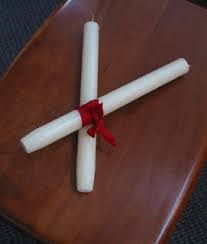
I got my throat blessed this morning, for this is the annual day when we observe that particularly wonderful tradition. The Blessing of Throats has long been one of my favorite sacramentals. I think it may be one of the nicest blessings we get to impart in the course of the Church's year. And how especially important this singular blessing is for us today, as for the second time, we keep this day and celebrate this blessing during this terrible time of deadly pandemic.

Over the centuries, the Church's catalogue of annual blessings has included blessing all sorts of things, such as horses on St. Stephen's Day and wine on St. John the Evangelist's Day, not to mention bonfires on the eves of St. John the Baptist and All Saints. Most of those blessings are barely even known by most people today. The blessing of St. Joseph's Table and the blessing of Easter Food remain popular in certain places, particularly among certain ethnic communities. Under the appropriate circumstances, almost anything and anyone can be blessed, but this particular annual blessing has a particular popularity - and persistence - virtually unequaled.

What accounts for this?

According to tradition, St. Blaise, in whose memory our throats are blessed on his feast day, was an Armenian physician, who became a bishop and was martyred early in the 4th century, and who supposedly healed a boy who was choking to death from fish bone. Devotion to him (and his healing powers) spread widely in both the eastern and western churches, which celebrate his memory on February 11 and February 3 respectively. In the medieval west, he achieved particular popularity as one of the "14 Holy Helpers." Like most pre-modern life, medieval life was hard, and help from almost any source was much valued and sought after! 

Of course, life can still be very hard even now - especially when serious illness intervenes as it has so dramatically and traumatically today. Hence, the perennial need for healing. 

Miracles matter, for life remains a challenge and so much of it is beyond our control, despite our modern pretense to the contrary. Certainly this calamitous covid pandemic has been for us one of the situations in which life on earth repeatedly shows itself beyond our very limited capacity to control. In this painful, beyond-our-control world, the blessing of throats instantiates the Church's prayer for the sick and highlights the Church's long-standing historical involvement in healing ministries. The fact that St. Blaise was himself a physician certainly speaks to the spiritual significance of the ministry of healing and the social value of all healing professions, all those doctors, nurses, PAs, EMTs, etc., who have given so much of themselves these past two years.

Through the intercession of St. Blaise, Bishop and Martyr, may God deliver us from every disease of the throat and from every other illness: In the name of the Father and of the Son and of the Holy Spirit.

Friday, January 28, 2022

The Quiet Light


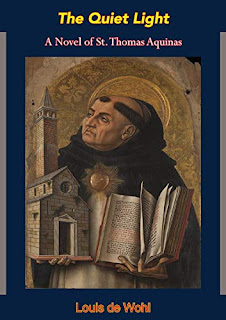
The Quiet Light is the title of a 1950 novel (photo) by Louis de Wohl, which told the story of the life of Saint Thomas Aquinas (1225-1274), whose feast the Church celebrates today. De Wohl set his story in the complicated and contentious context of the lives and conflicts of 13th-century medieval European nobility (notably Thomas's own family), and the battle between the Pope and the Hohenstaufen Holy Roman Emperor Frederick II (Stupor mundi). De Wohl's novel explores that world through the observations and experiences of a fictional English knight, Piers Rudde, and Robin, his squire, who somewhat improbably get involved in the fortunes of the aristocratic Aquino family in Italy - including especially the family's pious and super smart youngest son, the future Saint Thomas. De Wohl's novel fed my great hunger for tales about a world which was simultaneously so different and very far away from my own but also (because of the Catholic connection) so apparently accessible and comprehensible. De Wohl followed The Quiet Light with several other Catholic-themed historical novels, among them one about Saint Augustine (The Restless Flame) and another about Cassius Longinius (The Spear) - all three of which I read in high school - and a novel about Don Juan of Austria and the Battle of Lepanto (The Last Crusader), which I just recently read last year in connection with a local Catholic book club.

The Church rightly celebrates Saint Thomas's great contribution to the intellectual life of the Church, his contribution to the great medieval "synthesis of faith and reason." which involved the belated appropriation of Aristotle's philosophy in the Latin world. Where would Catholic social and political thought have been without Aristotle's vocabulary about citizenship and friendship. for example? 

Thus, the political and cultural conflict The Quiet Light portrays between the overlapping worlds of Frederich II and Saint Thomas is more than just an interesting literary dimension of the drama. It illustrates the secular alternative to what Aquinas accomplished. Frederick II is portrayed as what a later age would characterize as a figure of Enlightenment. He is genuinely interested in ideas - new ideas, especially imported ideas, ideas imported from the culturally more advanced (at that time) Islamic world. Aristotle reentered Europe in that era first through Arab philosophers and scientists. So the burning intellectual and cultural question was whether and how to integrate the increasingly attractive Aristotelian-Arab intellectual culture into Western Latin Christian civilization, for which it appeared to pose significant challenges along with opportunities. Frederick and Thomas represented radically alternate approaches to this movement of interpenetration and integration. Thomas's approach did a great service to the Church and for Western Latin Christian society. Frederick's approach represented an early anticipation of post-Christian, syncretistic, secular modernity.

Among the 37 Doctors of the Church, Saint Thomas is celebrated both as the "Angelic Doctor" (Doctor Angelicus) and also, for fairly obvious reasons, as the "Common Doctor," i.e., "universal teacher" (Doctor Communis). In his youth, however, he was supposedly nicknamed "the Dumb Ox," which famously became the title of G.K. Chesterton's wonderful little 1933 book about Saint Thomas's life and thought, which we also read when I was in school.

But one advantage of coming at Aquinas through a novel like The Quiet Light was that no one could conceivably imagine him as some sort of "ivory tower intellectual" (whatever that silly expression means), someone disconnected from the social conflicts and struggles of his time. Ultimately even more fundamental to appreciating Thomas the scholar and Thomas the exemplar of high medieval life and culture, of course, was Saint Thomas the priest, the Dominican friar, sharing his religious order's life of contemplative prayer with the world. One is directly reminded of that at every celebration of Benediction of the Most Blessed Sacrament, when all sort of people join together to sing those wonderful Latin hymns which Saint Thomas composed as part of the Office for Corpus Christi.

For centuries, the Church celebrated Thomas's feast on March 7, the anniversary of his death in 1274. De Wohl's novel created a fictional scene in which he imagines Thomas  celebrating Mass one March 7 and lamenting that it wasn't a saint's day. Actually, in fact, in Thomas's time it would have been the feast of the 3rd-century North African martyrs Saints Felicity and Perpetua. When Saint Thomas was added to the calendar, Perpetua and Felicity were reduced to a commemoration, but then in 1908 they got their own feast day again, anticipated on March 6. As graduate students in 1974, we celebrated the 700th anniversary of Saint Thomas's death with the late Professor Paul Sigmund (who had recently spoken at a conference commemorating the anniversary) at dinner at the Princeton Graduate College. 

The 1960 calendar reform in the Roman Rite gave liturgical precedence to the lenten weekdays effectively reducing Saint Thomas to a mere commemoration in the lenten Mass and Office. But then the 1969 calendar reform of Pope Saint Paul VI resolved this awkwardness by moving Thomas' memorial outside the lenten season. That was how Saint Thomas got moved to today, the anniversary of the transfer of his relics to Toulouse in 1369. My guess is that that is how "Catholic Schools Week" likewise migrated to the end of January, because, of course, Saint Thomas is also the patron saint of Catholic schools.

Besides eucharistic hymns, Saint Thomas also composed prayers, for example this one of which I am especially fond: 

Grant, O Lord my God, that I may never fall away in success or in failure; that I may not be prideful in prosperity nor dejected in adversity. Let me rejoice only in what unites us and sorrow only in what separates us. May I strive to please no one or fear to displease anyone except Yourself. May I see always the things that are eternal and never those that are only temporal. May I shun any joy that is without You and never seek any that is beside You. O Lord, may I delight in any work I do for You and tire of any rest that is apart from You. My God, let me direct my heart towards You, and in my failings, always repent with a purpose of amendment.

Tuesday, January 25, 2022

The Gilded Age on HBO


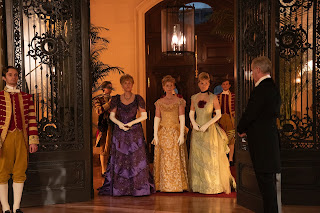
Famous forever already as the creator of Downton Abbey, Julian Fellowes has now added to his résumé a new historical drama, The Gilded Age, set in New York during the so-called "Gilded Age," the boom years of 1880s. The series has nine episodes, the first of which, "Never The New," was aired on HBO last night.

It was the 1970s British series Upstairs, Downstairs that first set the standard for such enterprises. Downton Abbey, while very different in certain respects, reprised the Upstairs, Downstairs motif of an upper-class English family and their servants, going through the ordinary stresses of family life magnified by the complications of historical change. Both series spanned British history from the late Edwardian era through the traumatic experience of World War I to the 1920s. Both endeared themselves to their audiences through the incredibly interesting and well-played characters (both upstairs and down) as well as through the equally interesting experience of watching and epoch dramatic historical changes and the impact of those changes of a traditional way of life going from a social norm to a no longer normative relic of a bygone past, a pst not really missed in practice but much romanticized in theory.

Setting The Gilded Age in New York in the boom years of 1880s breaks that mold, no matter how many rich people, fancy houses, beautiful outfits, and servants still populate the screen. Fellowes, et al., have assembled a fantastic cast, who should be able to do wonders with this story. And perhaps they will. The first episode basically introduces everybody and the thematic storyline and leaves us wondering what more there is for them to do.

In a sense, The Gilded Age is ill-served by comparisons with either Downton Abbey or its illustrious predecessor Upstairs, Downstairs. First of all, it is not about actual aristocracy and all the deference that accompanies it, because it cannot be. It is set in the U.S., which however unequal a society simply did not have the appropriate feudal cultural inheritance. Secondly, whereas the more famous British series were about aristocracy in a slow process of historical decline, this series seems as much about a pseudo-aristocracy (the "old money" families with pedigrees back to colonial times) being replaced by an oligarchy of "new money." While the rise of the "middle classes" was an underlying Downton Abbey theme (e.g., Cousin Matthew's "middle-class" background and ideas, Lady Mary's  unsuitable fiancé Richard Calysle, Lady Edith's lover Michael Gregson, etc.), The Gilded Age is inherently about the rise of the new class of plutocrats, who are more "middle class" in background and outlook compared with the "old money" they are displacing, who are, of course, less aristocratic than they pretend to be.

The Gilded Age recalls a real period in American history. Of course, what was ultimately much more interesting about the 'new money" dominance was not its displacement of a pseudo-aristocracy of "old money" but rather its destruction of whatever was left of the earlier egalitarianism of the colonial, founding, and Jacksonian eras. That would make a less interesting interpersonal drama. Hopefully, the series can make more interesting the alternative, if somewhat contrived, interpersonal drama of competition among complacent rich women resisting the rise of ambitious rich women.

Because this is HBO and because this is 2022, the series seems to be aiming at a more contemporary feel in regard to the range of issues addressed. Unlike Europeans, who have an authentic feudal heritage and hence understand class, Americans tend to resist acknowledging the reality of class and class conflict. Race. on the other hand, has been a conflict in American history from its beginning, and has often served as a surrogate for what might otherwise be class conflicts. The Gilded Age presents itself primarily as a class conflict within the ultra-rich, but very early on introduces the complex and fraught issue of race through the seemingly improbable friendship between two of the main characters, through whom we get to see some of the challenges and difficulties of being Black (albeit northern, somewhat middle-class Black) in post-Civil War ebulliently capitalist New York. Whatever the series will do with that dimension of the story, it has the potential to enrich the interactions of otherwise apparently one-dimensional characters. The same, potentially, for the series' (equally improbable) foray into sexual diversity in late 19th-century upper-class experience.

After only one episode, while aspects of the storyline are obvious and where individual characters are headed also seems obvious, it remains to be seen how they will be developed and what surprises may still be in store.

(Photo: The New York Times)

Sunday, January 23, 2022

A Preacher of Truth in the Whole World


On July 7, 1858, Servant of God Isaac Hecker together with 3 others founded the Society of Missionary Priests of Saint Paul the Apostle, known ever since as “The Paulist Fathers.” Three days later they were assigned by Archbishop John Hughes the pastoral care of a new west-side parish, named for Saint Paul the Apostle. For more than 160 years, this parish - together with the Paulist Fathers’ life as a religious community in the Church and their wider missionary outreach - have been blessed by the patronage of Saint Paul the Apostle, the feast of whose Conversion we anticipate today.


Most saints are celebrated on the anniversary of their death. If the saint was a martyr, that itself is often his or her principal claim on our attention. Along with the Apostle Peter, Paul was martyred in Rome, the subject of Robert Reid’s impressive painting above the altar of Saint Paul on the south side of the church. Saints Peter and Paul are celebrated together every year on June 29. But then, every January, there is this additional celebration of Saint Paul – focused on the event in his life that we now commonly call his “conversion.” That great event, monumentally portrayed by Lumen Martin Winter over the main entrance to the church [photo], transformed Paul into a disciple of Jesus and put him on an equal footing with the others to whom the Risen Christ had appeared. Now as then, that event highlights for us what it means to be converted to Christ, to become a disciple of Jesus, his witness in the world, and an apostle sent with mission to evangelize, to make disciples of all peoples.  He became what the beautiful mosaic on the floor of the church behind the altar here calls “A Preacher of Truth in the whole world.” No wonder Hecker and his friends chose Paul as their patron!


To understand Paul and appreciate his impact, we do well to remember that Paul was, first and foremost, a devout Jew, well educated in the Law, a Pharisee, that is, a member of the group most zealous about religious observance. But he was also a Greek-speaking Jew, from what we call the Diaspora, those living outside the land of Israel. He grew up in what is today Turkey, in a Greek city, and enjoyed Roman citizenship.


All of this was very important, because one of the great issues which confronted the 1st century Church was figuring out how Jews and Gentiles were connected in God’s plan for the salvation of the world through Jesus Christ – and how Jews and Gentiles should relate to one another within the one community of the Church. The way this issue was eventually resolved (thanks in no small part to Paul) helped transform what would otherwise have been a small Jewish sect into the biggest and longest-lasting multi-cultural institution in the world.


What Paul experienced when he met the Risen Lord on the way to Damascus was a revelation of God’s plan to include all people in the promises originally made to Abraham and his descendants and now being finally fulfilled in Jesus. The God who revealed himself to Paul in the person of Jesus was the same God whom Paul had always served so enthusiastically as a Jew. What changed was that now Paul recognized Jesus as the One, though whom all people are included in God’s plan of salvation.


And because the newly converted Paul now understood that it was Jesus that ultimately mattered, he also recognized no conflict between Gentile culture and faith in Christ. For the pagan peoples of the Roman Empire, that was good news indeed. It’s easy to see why Paul’s mission was so successful among different types of people and why he appealed to Hecker as a model – Hecker who was so convinced that the Catholic Church was just what American culture needed. The world has changed a lot since Hecker’s time (not to mention Paul’s time), but the Church’s mission - our mission - remains the same.


Paul had what Hecker so much wanted his Paulists to have, what Hecker called “zeal for souls.” Paul was not one of the original 12. He wasn’t there when Jesus said to his disciples: “go into the whole world and proclaim the gospel to every creature.”  But he absorbed those words as surely as if they had been initially addressed to him – as we also must do.


As Pope Saint John Paul II famously said: “Those who have come into genuine contact with Christ cannot keep him for themselves, they must proclaim him.”

Homily for the (Anticipated) Parish Patronal Solemnity of the Conversion of Saint Paul,              Saint Paul the Apostle Church, NY, January 23, 2022.

Saturday, January 22, 2022

Catholic Discordance (The Book)


"Massimo Borghesi leads us through a very readable analysis of the neoconservative, largely American, detractors of the magisterium of Francis. ... the defenders of capitalism ... who overly identify the faith with its moral teachings." So writes Bishop John Stowe, the wonderful Bishop of Lexington, Kentucky, on the front page of Catholic Discordance: Neoconservatism vs. the Field Hospital Church of Pope Francis (Liturgical Press, 2021), by Massimo Borghesi, translated by Barry Hudock. Borghesi is professor of Moral Philosophy at the University of Perugia and author of The Mind of Pope Francis (2018), also translated by Barry Hudock.

Borghesi's book is about Pope Francis and his agenda, but focuses on Francis' pontificate through the lens of what he sees as the "delusional example of the theological-political Manichaeism circulating in some segments of the church" - notably U.S. neoconservative Catholicism. Personally, I wonder whether he overuses (maybe even misuses) the word Manichaeism much too much. Indeed, the word might well be just as applicable to some alternate factions to which Borghesi is more sympathetic. On the other hand, his emphasis on the apocalyptic aspect of such movements seems more apt, as when he describes "the ideological framework that permeates so much of American Catholicism, one of culture wars, end-time struggle—children of light versus children of darkness."

Apart from an excursus on American neoconservatives' attempts to exercise influence in Italy, the author's dominant focus is very much on the U.S. situation and its influence. The "misunderstanding" he diagnoses as "the foundation of the Catholic neoconservative, or Christianist, position" is "the identification of faith with Western civilization. This was denounced by Jacques Maritain in 1936, in his book Integral Humanism."

Borghesi invokes all three of the most recent popes - John Paul II, Benedict XVI, and Francis - as a consistent alternative to American Catholic neoconservatism. My favorite papal quote he takes form Pope Benedict: "the New Testament is aware of political ethics but not of political theology.” Borghesi's basic warning "is that every time a theological movement follows a political one, it shares its successes and defeats; it gives up its own autonomy. This is the fate of political theologies."

The book is especially useful for its historical treatment of the trajectory of American Catholic neoconservatism. "which since the 1980s has taken the place of the Catho-Marxist messianism of the 1970s," and "is a conservative political theology, a right-wing variant of left-wing political theology." In Borghesi's rendering of recent Roman Catholic history, in the years after Vatican II, "which were marked by intense theological disputes and, in some segments, an attempt to understand Christianity through a Marxist lens—the church seemed to establish, with the pontificate of John Paul II, a renewed sense of identity and balance." The future Pope Francis was attracted to John Paul's "path by which the church could avoid the two siren calls of reactionism and revolution."

A particularly insightful aspect of Borgghesi's analysis is that with Communism's fall, the moral dimension of anti-communist ideology was lost, which "explains why the era of globalization coincides with a much more radical secularization of Western life than occurred during the 1960s and 1970s. The primacy of the economy, with a new type of financial capitalism, coincides with the decline of politics, ethics, and religion. The ideal that stood in contradistinction with Marxist ideology disappeared, and a cynical and soulless pragmatism based on an individualistic, Hobbesian-Darwinist anthropology triumphed. Faced with this 'anthropological mutation,' which had been clearly foreseen in the 1970s by Pier Paolo Pasolini, the church stood bewildered and unprepared." In the U.S., "The secularization of the North American landscape and in particular of the Democratic Party pushed Catholics into the Republican sphere, with its typically Protestant combination of defense of the family and the free market." 

One key to this, which is sometimes insufficiently emphasized, is that, being on the left after the fall of communism, has "meant cultivating an individualistic, radical liberalism that elevated physical and individual desires as a model of human progress in general. Poverty, social inequalities, workers’ rights, economic justice, and collaboration between the state and civil society in management of the economy disappeared from the view of the new left. It became libertarian and pleasure-seeking, measuring quality of life solely by one’s personal sense of psychosocial well-being." In this context, the Church increasingly embraced "conservative positions, in reaction to a relativistic and optimistic postmodernism, coincided with an ecclesial “retreat,” a closure from and distrust of a world perceived as hostile, alien, enemy."

The dangerous irony in this was that this militant "dialectical model," with its dismissal of "mission and dialogue," applied only to a narrow set of "life issues." In other areas, "a decisive conformism reigned. The rejection of the spirit of secularization was accompanied by an unconditional embrace of a capitalist model, which, ironically, was the real engine of the very secularization that was supposed to be the enemy. Hence the impotence of a struggle that bears within itself a contradiction: opposition to the relativism and individualism created by economic processes that are accepted enthusiastically."

His historical account focuses especially on figures like Michael Novak (author in 1982 of The Spirit of Democratic Capitalism), who, Borghesi argues, advocated "a Catholicism modeled on the American lifestyle." For Borghesi's Novak, "cooperation between capitalism and modern Christianity excludes the idea of solidarity. It also excludes any critical appraisal of the liberal model." It is a bourgeois Christianity, in which "it is the economy that dictates the ethical model rather than vice versa."

Novak was part of "a very active group of intellectuals who, in the span of a few years, managed to establish themselves as the shapers of the American Catholic conscience." This group, which also famously included former liberal Lutheran minister and convert to Catholicism, Fr. Richard Neuhaus, "was part of a neoconservative galaxy dotted with intellectuals, disappointed by the left and by the politics of the Democratic Party."

One of the noteworthy things these intellectuals did, according to Borghesi, was to distort papal teaching - notably Pope John Paul II's encyclical Centesimus Annus. "The result was that a text that was strongly critical of neocapitalism came to be understood as an apologetics manual of the same." This distortion of Catholic social teaching has been a hallmark of this movement. Borghesi, in contrast, stresses the anti-capitalist continuity of papal teaching from Pope Paul VI through Popes John Paul II and Benedict XVI to Pope Francis. whose Evangelii Gaudium "cast sharp doubt on the Catholic neoconservative agenda and criticized its assumptions plainly." Borghesi highlights the contrast between Francis's Church in uscita [going out] and the "ecclesial introversion" he opposes.

For Borghesi, Francis "is a pope who truly expresses the intimate popular-Christian religiosity of Latin America and, precisely for this reason, stands outside the ideological dialectic typical of Catholicism between progressives and reactionaries" and "overturns the Catholic neoconservative model wholly polarized by moral issues."

Faced with the opposition by Pope Francis, "the neoconservative movement, with its dual religious and secular soul," seem to have formed an unlikely alliance: "the strange alliance between conservative liberals and Catholic reactionaries hostile to the Second Vatican Council that would constitute the shock wave against the Francis pontificate. Conservative liberals and Catholic traditionalists—diametrically opposed on the topic of the value of modernity—combined forces in the ethical battle against relativism and in unquestioning fidelity to the western capitalist model."

The ultimate example of Catholic neoconservatism's intellectual decline as an ideology is, of course, the political alliance with Trump, to whose fate it seems increasingly tied.

"Like any political theology, Catholic Americanism depended on the fate of the power to which it linked itself."