Friday, March 4, 2022

What It Took To Win (The Book)

Georgetown University American historian Michael Kazin, who has previously written books on labor history and populism (including a biography of William Jennings Bryan), and who has a personal life story of political activism (including at one time membership in SDS), has now given us What it Took To Win: A History of the Democratic Party (Farrar, /Strauss, and Giroux, 2022) to tell "the story of how the oldest mass party in the world contended for power and what its leaders did with it when they won."

His central unifying theme is that Democrats "have insisted that the economy should benefit the ordinary working person, whether farmer or wage earner, and that governments should institute policies to make that possible—and to resist those that do not. ... When Democrats made a convincing appeal to the economic interests of the many, they usually celebrated victory at the polls." Kazin employs the concept of "moral capitalism" (a term borrowed from the work of historian Lizabeth Cohen) to describe both the party's ideals and the policies inspired by those ideals. Unlike socialists. Democrats "understood that most voters saw no alternative to the system of markets and wages, and they did not try to offer one. But they also believed, quite accurately, that the capitalist order failed to produce the utilitarian ideal of the greatest good for the greatest number." The party's most successful periods, when it had durable majorities, were from the late 1820s through the 1850s and from the 1930s through the 1960s, "eras when the Democrats argued persuasively about their commitment to make the economy serve ordinary people."

In Kazin's analysis, the Democratic party's "moral capitalism" has combined two tendencies. The first, which was dominant throughout the 19th century and into the Great Depression, was "a harsh critique of concentrated elite power—'monopoly,' whether of high finance or manufacturing or a corrupt alliance between private wealth and public officials." It envisioned "a society of small proprietors or at least of a government that strictly regulates larger ones and often requires them to redistribute part of their wealth, usually through progressive taxation." This tendency "was able to unite such disparate social forces as Southern planters and Irish Catholic immigrant workers behind a shared animosity toward Northern industrialists, high tariffs, and Wall Street speculators."

The second tendency attacked "the oppression of Americans in the workplace, whether by poor working conditions, bad wages, insecure employment, a ban on union organizing, or other indignities" and sought "to unite wage earners and their sympathizers in every region." This "pro-labor theme largely replaced the anti-monopoly one in the 1930s and defined the party’s message and animated the key members of its coalition through the 1960s."

Fans of American political history will appreciate Kazin's account of the party's successes and failures. He starts from the beginning with Thomas Jefferson's southern based "Democratic-Republicans" and the creation of an actual political party in the 1820s with Andrew Jackson and Martin Van Buren. Unlike later iterations of the Democratic party, antebellum Democrats institutionalized a "populist suspicion" that "an interventionist federal government would always benefit the rich and the well-connected." 

The 19th-century Democrats were the world's first mass-based, modern, and democratic party, and Kazin recounts in considerable detail the party's successful outreach to immigrants, welcoming immigrants "from every European nation and religion" (in contrast to, first, the Federalists and, then, the Whigs). But, the Federalists and the Whigs (and their eventual heirs, the Republicans) gradually led the way to the abolition of slavery, an issue which caused a temporary breakup of the Democratic party - and the Union - and led to a period of national Republican dominance after the Civil War.

Throughout the book, Kazin keeps recalling the decisive fact that the Democratic party's populist economics and inclusive politics excluded African-Americans. A mere 17 Democrats in Congress voted for the 13th Amendment in 1865, and no congressional Democrats voted for either the 14th Amendment in 1866 or the 15th Amendment in 1868. During what Mark Twain called the "Gilded Age," the Democrats simultaneously "used illegal and legal means to prevent most Black men from exercising the franchise" in the south, while in northern cities, they "worked just as hard to persuade adult male residents to vote, including countless European immigrants they rushed to naturalize." (This was the era when the Democrats were widely referred to as the party of "Rum, Romanism, and Rebellion.")

By the transition from the 19th to the 20th century, "bosses both North and South had become rather consistent voices for at least the white victims of Gilded Age capital." In the process, those (like Grover Cleveland) "who clung to the Jacksonian notion that federal power would always benefit the rich and privileged were exposed for doing just that instead of aiding the unemployed and the indebted." This led to what Kazin calls "the most consequential rebuilding of the party since its creation." 

A Bryan biographer, Kazin unsurprsingly highlights the significance of William Jennings Bryan's three runs for the White House and his role in modernizing the party, highlighting how Bryan rejected "the skepticism about government intervention in the economy held by each of his party’s standard-bearers from Andrew Jackson to Grover Cleveland." Bryan was also "the chief forerunner of a style of politics inextricably bound up with personality that we now take entirely for granted."

After Bryan, Kazin considers important figures in the 20th-century transformation of the party such as Alfred E. Smith and Robert F. Wagner. And while the white-ruled agrarian south continued to dominate the party, the Democrats for the first time were attracting an "influential new constituency that remains with them still: left-leaning intellectuals from the urban North."

The post-World War I period was disastrous for the party, seemingly perpetually mired in minority status and internally divided between southern and western white evangelical Protestants who backed Prohibition and the largely Catholic “wets” from New York and other big Eastern cities. But in the new post-19th-amendment world, "a largely unheralded band of white female Democrats blazed a path to future victories by advocating reforms to improve the lives of working-class people." This group comprised "erstwhile social workers like Frances Perkins and Belle Moscowitz, trade unionists such as Rose Schneiderman and Mary Dreier, popular journalists like Emily Newell Blair, the tiny number of Democratic women who held public office, and one future first lady" (Eleanor Roosevelt). In this same period, the Democrats belatedly developed "a national organization that did business all year long instead of coming to life before each campaign and going dormant once voters had their say."

Meanwhile, the New Deal represented the first crack in the established racial party patterns as for the first time, northern African-Americans switched to the Democratic party. At the same time, the New Deal made the Democrats "the closest thing the United States would ever have to a party dependent on the support of organized labor." And it was organized Labor, which Harry Truman famously credited for his upset victory in 1948. Kazin highlights the symbolic significance of the fact that "every Democratic nominee for president from Truman in 1948 to Lyndon Johnson in 1964 kicked off his fall campaign with a Labor Day speech to a big union crowd gathered in Cadillac Square."

1948 was also the year that Hubert Humphrey's oratory got the Democrats to include a civil rights pledge in he party's platform - causing the "Dixiecrat" walkout. The party's transformation was slow. At its 1956 convention, John F. Kennedy narrated a film about the party's history that was silent about its racism and praised Andrew Johnson, and for most of his presidency, "JFK was largely a bystander in the bourgeoning struggle against Jim Crow." The decisive change came, of course, with his successor, Lyndon Johnson, who (with Republican help) passed the Civil Rights Act of 1964 and the Voting Rights Act of 1965, and, as he famously said, “delivered the South to the Republican Party for your lifetime and mine.”

Kazin emphasizes how Johnson's War on Poverty "had forgotten a primary lesson of the New Deal." Whereas FDR had enacted measures that Democrats "could credibly claim served the needs of the great majority,"most of LBJ's measures (except for Medicare and aid to education) were "viewed as benefits to poor and mostly non-white Americans."Kazin describes this as "a sincere appeal to the better angels of the nation, but it was not effective politics." And then, of course, came Vietnam, which effectively "destroyed the Cold War consensus that had united Democrats across regional and ideological lines since the years when Harry Truman governed in the White House while Joseph Stalin ruled from the Kremlin." The result (in the words of historian Nelson Lichtenstein) was that the Democratic nomination contest in 1968 “was the last moment in the twentieth century when the most decisive issues facing the nation would be fought out within the house of American liberalism.”

Kazin takes the reader through the familiar saga of the party's past half-century. The FDR-era of mass prosperity and diminished inequality ended. Desperate voters "searched the political landscape for figures who could offer effective remedies, if not permanent solutions. But no Democratic faction satisfied their demand; stymied by internal conflict, the party as a whole never seriously tried. Instead, most of its leaders, elected and otherwise, either acquiesced to or promoted austere budgeting and market-based solutions, elements of the policy agenda later known as 'neoliberalism'.” Meanwhile the party increasingly came to be seen as the party of educated liberals and of threats to traditional values held by many preciously Democratic constituents.

Kazin is very critical of Carter, "the most right-wing president since Calvin Coolidge," and somewhat critical of the more recent Democratic presidents, Clinton and Obama. The Clinton-era 1994 midterm defeat effectively ended "the party’s dominance over the legislative branch in spectacular fashion." While Clinton's own reelection stalled the right's political progress, by the end of his term "the party once known for fighting for the interests of wage earners and small farmers against big business now seemed intent on rolling back nearly any regulations that made CEOs unhappy." Obama was, of course, the first African-American president, a symbol of the moral transformation of the former party of white supremacy, but he also represented the rise of "cosmopolitan academics." Kazin's verdict on Obama: "One of the most inspiring Democratic candidates in history thus committed one of the cardinal errors in politics: he dispirited and demobilized his base."

Then came Donald Trump, whose election "accelerated the leftward shift among Democrats that had been building over the previous decade." But, Kazin concludes, "Democratic activists could not perceive their institution as akin to a social movement. The job of a political party in a democratic system is to win elections and then pressure officeholders to carry out policies their voters desire. In contrast, social movements exist to articulate alternative policies and make strong moral pleas for a single issue or more. Their job is not to win over a majority, but to persuade the minority who identify with them to change the way power works."

A particularly good point to ponder against the party's present trajectory!


Thursday, March 3, 2022

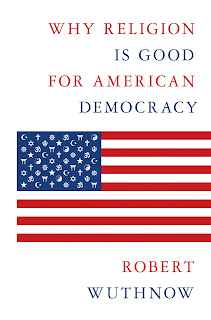
Why Religion Is Good For Democracy (The Book)


Princeton Professor emeritus Robert Wuthnow has written yet another book about religion, Why Religion Is Good for American Democracy (Princeton U. Pr, 2022) makes and develops his claim "that religion is good for American democracy less because of the unifying values it might provide and more because of religion's capacity to bring diverse values, interests, and moral claims into juxtaposition with one another." Drawing on studies of religion in ordinary life, he conceptualizes "religious practices in terms of action, conviction, and contention, meaning that they are something people do because they are convinced that what they are doing is right, and they hold these convictions in contention with behavior considered less desirable and indeed wrong."

B far, the more interesting parts of the book are Wuthnow's compelling accounts of historical and recent examples of how religion has played this role in American democratic politics.  The first such account concerns the New Deal period. Wuthnow recounts the history of religious responses to the New Deal. He particularly highlights religious-based opposition to the New Deal, which coincided with the fear "that local control of the kind present in families, churches, and communities would be replaced by government, codes, rules, and regulations." Probably the most famous Catholic opponent of the New Deal was, of course, the infamous Fr. Charles Coughlin, while Southern Democrats' resistance "occasioned the return of a Christian-based populism that would surface repeatedly in small-government appeals." Wuthnow contends that the religious reactions to the New Deal contributed "to the debate about what democracy should be, how it should be practiced, and what it implied for American values and for religion."

In a similar way, Wuthnow examines the wartime debates about pacifism, war, and conscientious objection, and postwar worries about social conformity and dissent. "Although it is true that religion in the 1950s was conformist," the author argues, "it was organized around diverse traditions and its growth was realized not only in membership but also in an expansion of the institutional forms it had been developing since the end of the nineteenth century. Its contribution to democracy was less a consensus around an Americanized ideal and more a convergence of perspectives about the strengths of American democracy and the challenges facing it.." Thus, for Wuthnow, the freedom of religion hailed by Americans in the 1950s created spaces "for a much wider variety of forms and ideas to take root."

Wuthnow continues this approach, bringing the discussion up to date, with accounts of religious perspectives and debates about the roles of the state and private charity in welfare provision and the religiously fraught issues of immigration and citizenship and of wealth and economic inequality, ending with a chapter on faith communities and the pandemic. He concludes that "much of the past century's religious history has been dominated by the tension that ran through all the various traditions between upholding the distinctive rights and freedoms of religion, on the one hand, and, on the other hand, joining with nonreligious groups and government in the interest of making a difference in the wider world."

What Wuthnow calls "underappreciated contribution of the various religious groups and coalitions," he contends, "has been their role in filtering, digesting, and in many instances countering the dominant national rhetoric - doing so through local networks and by focusing on practical concerns inadequately addressed through electoral politics."

One area in particular which "religious diversity has contributed least to resolving is systemic racism." Therefore, he considers it particularly important "that Black churches and coalitions of African-American civil rights and community service organizations have contributed significantly to all the major deliberations the nation h as faced in deciding  what it means to be a democracy that upholds liberty and justice for all."

Wuthnow's account and analysis of how religious groups have been participants in important debates in American history offers a helpful background for our current climate in which religious identities have increasingly become symbolic and tribal markers in our contemporary political polarization, while religious organizations and institutions have themselves sometimes become antagonists in contemporary culture war politics. Even without and apart from such seeming distortions of religion for political purposes, this book should highlight our appreciation of religion's past and present contributions to important political conflicts and so encourage proponents of a lively democratic pluralism.

Wednesday, March 2, 2022

Ash Wednesday


There is no island, no continent, no city or nation, no distant corner of the globe, where the proclamation of Lenten Fast is not listened to. Armies on the march and travelers on the road, sailors as well as merchants, all alike hear the announcement and receive it with joy. Let no one then separate himself from the number of those fasting, in which every race of humankind, every period of life, every class of society is included.

So said Saint Basil the Great (330-379) preaching about the beginning of Lent back in the 4th century, at a time when the Lenten Fast was taken much more seriously than it is today. In contrast, because we no longer observe anything resembling the traditional fast, Lent has lately acquired a bit of an identity crisis. Hence our strange preoccupation with what to do differently, or special, or extra, or less of (as in "giving something up") for Lent.

Ash Wednesday didn’t even exist yet in Saint Basil’s time.  The custom of everybody flocking to church to get ashes was a relative latecomer to the Lenten liturgy. But, unlike the fast, it has survived – and thrived. It seems now that almost everyone wants ashes on Ash Wednesday. 

For many who come to get ashes on Ash Wednesday, it is a deeply, religiously spiritual experience. For many others, who can even guess what multitude of complex meanings and imaginings the reception of ashes may have? On the other hand, who can deny the power of God's grace that must surely be at work in drawing so many to church to get those much desired ashes?

The use of ashes, the Church reminds us, “symbolizes fragility and mortality, and the need to be redeemed by the mercy of God.” Remember, The Church tells us today, that you are dust, and to dust you shall return. What is it about having dirt smudged on one’s face and being reminded that we are going to die that is so amazingly attractive?

Every year, I used to ask that question at Mass on Ash Wednesday, and I usually answered it with some variation of "because it is true." In this “information age” when we are all bombarded on all sides with images and words we cannot even begin to process, in this politicized age of “alternative facts” and just plain old-fashioned lies, not to mention the Republican "Big Lie" about the 2020 election, for once at least we are being told something that is simply and unambiguously TRUE.

The last time I asked that question in an Ash Wednesday homily was two years ago in February 2020, almost literally on the eve of the covid pandemic, that very vivid evocation of our morality and fragility, which would shortly shut down for a while even the church where I was pastor. I remember that occasion well because that was also the day when my mother was suddenly taken to the hospital, where she would die nine days later. What very vivid and unambiguous experiences of the fragility of everything we expect and count on in life!

We live in a therapeutic age which prizes safety, comfort, and feeling good about oneself.  Yet each year Ash Wednesday, with its sobering message of mortality and fragility and its solemn challenge to repentance, somehow still cuts through the poisonous political platitudes and psychobabble of our age to speak spiritual truth against the powerful lie of our narcissistic self-absorption.

Today, the Church invites us to break out of our routine and do something we usually seem so reluctant to do – to take an honest and critical look at ourselves, at where we have been, where we are going, where we would like to be going, and how hope to get there.

Tuesday, March 1, 2022

The State of the Union


Once again it is time for that predictably ridiculous ritual, the State of the Union Speech. It is, of course, an actual speech, but in many ways it seems more like a pantomime, which is defined as "a dramatic entertainment, in which performers express meaning through gestures." How else should one describe this combination of artificial ceremonies intended to impress a certain monarchical dignity upon the occasion, combined with completely undignified interruptions for partisan applause and jumping up and down on cue to highlight tribal identities and loyalties? Yes, it is a speech full of words - typically too many words - but it is the official rituals of ersatz kingship and the partisan playacting that make the occasion what it is (or at least what it has become since it first became a TV spectacle half a century ago). For authentic political dignity in contrast, compare our State of the Union pantomime with the Ukrainian President's speech today to the European Parliament!

The President is, of course, commanded by the constitution to report to the Congress on the state of the union. He is not required to do so in person, let alone on TV. Who knows if next year a Speaker Kevin McCarthy (or a Speaker Donald Trump) may decide to ratchet up the Republican party's commitment to the erosion of civility and democratic norms even further and choose not to invite President Biden to come in person to deliver the speech. (After all, how does one profess the "Big Lie" about the 2020 election and then exercise "the distinct honor and high personal privilege" of introducing the President of the United States?) Such a further erosion of civility and democratic constitutional norms would be a tragedy, but in itself the absence of the State of the Union pantomime maybe not.

It was exactly two years ago that candidate Joe Biden reclaimed front-runner status (after having been written off by pundits and political ideologues). It was exactly two years ago that it suddenly became obvious that only Biden could create a coalition that could defeat Donald Trump.

Tonight's speech, for all its ridiculous staging, is an occasion for the President to try to recover some of that momentum and recreate a coalition that can again unite to defeat Trump and Trumpism. Tonight's speech is just a potential opportunity, however. For in today's world of polarized partisan media and diminished personal attention spans, neither the conventional State of the Union laundry list of policy proposals nor the accompanying partisan pantomime performance may produce much positive movement. It is, however, an opportunity to reclaim center stage with the right gestures and soundbites, celebrating what this Administration has accomplished that actually matters in most people's lives, while refocusing Americans' distracted attention by offering an attractive alternative to the dangerous appeal of Vladimir Putin and his American surrogates.


Monday, February 28, 2022

The New Iron Curtain


Militarily, the Russians may have most of the conventional advantage, but the heroic Ukrainian resistance is at least inflicting on the Russians a serious bloody nose. Good for them! Ukrainians know well, from their own recent history, what it means to be swallowed up by the Evil Empire, and they obviously want no part of it.!

Meanwhile, the U.S. and our European allies are responding - rather fitfully, hardly heroically, but at least (surprisingly) united and consistently. Sanctions and threats of more sanctions obviously did not deter Russian aggression, and it remains to be seen how united and consistent the U.S. and our European allies are going to remain. Both the U.S. and Europe (especially Europe) have gotten amazingly comfortable with the historically exceptional experience of relative effortless peace and security on the European continent.

There have, of course, been previous periods of relative peace and security in Europe - almost an entire century (with brief interruptions) from 1815 to 1914 - periods of peace maintained by conscious and careful efforts to enforce a salutary balance of power. Apart from the NATO expansion at the end of the last century (for which in retrospect we should all be very thankful), the predominant impression has been one of ahistorical fantasy - a fantasy that peace and security somehow can be guaranteed simply by imagining it to be natural instead of the consequence of hard work and effort. But preserving peace and maintaining a secure balance of power in a dangerous and easily disrupted world are never automatic and are never produced merely by imagination.

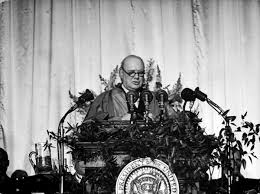
When I was a boy, back in the Cold War 1950s, my family frequently listened to the radio news at dinner time. I remember repeatedly hearing about the "iron curtain" and childishly trying to imagine how a curtain could be made of iron, and how horrible such a thing would have to be. In fact, of course, the iron curtain was a metaphor for a reality which truly was horribly evil.

There is nothing inherently inevitable about President Putin's personal commitment to re-establish that iron curtain in the form of a politically isolated, economically impoverished, and culturally repressive imperial enclave, historically and symbolically buttressed by a traditionally supportive and compliant Orthodox Church (always a more effective expression of Russian imperial imagination than the Communist Party was, whose Patriarch has just recently recalled the Russians' and Ukrainians' "common centuries-old history dating back to the Baptism of Rus by Prince St. Vladimir the Equal-to-the-Apostles.") Yet such seems to be the bleak future Putin is promising his people in Russia and whatever borderlands Russia can conquer.

So, once again, it falls to the U.S. and our (hopefully united) European allies to contain Russia's expansionist political aspirations and keep it isolated in its self-imposed, self-destructive cultural enclave, until in time, like its Soviet iteration, it implodes from its own inherent internal moral corruption.

Photo: Winston Churchill's famous 1946 "Iron Curtain" Speech, Fulton, Missouri.