Monday, March 28, 2022

An Unusual Night at the Oscars


On Sunday morning, I read (and agreed with much of) Ross Douthat's NY Times column critiquing the academy Awards and the industry they are meant to self-congratulate. Then, Sunday evening, I went ahead and watched the Oscars. To be honest, I did it as much for the companionship of enjoying a fun evening with others than for the time-tested boredom of watching privileged people celebrate themselves. Prior to the pandemic, I used to go to the movies quite often, and so was much more likely to be familiar with many of the films and actors being feted on the Academy stage. Since then, I have barely entered a movie theater, which means my access to major films has depended on my access to a complicated collection of competing streaming services (or access to others who have access to those services). So, I have seen only a few of the nominated films, this year not including the Best-Picture winner. 

Given my low expectations, I did enjoy some segments of the show, although I suppose I showed my age in enjoying most of all the 50-year retrospective on The Godfather movies. It was nice to see some actors I admire and to be introduced to current stars I barely know anything about. I appreciated the way at least some of the awards were speeded up, omitting the tediously pointless prelude to opening the red envelope. But, by and large, I was indifferent to most of the changes in the show's format.

Of course, what made this thoroughly forgettable annual glorification of wealth, good looks, and ugly clothes unexpectedly memorable was its one unscripted moment, the sudden intrusion of authentic human emotion. I refer, of course, to one actor's passionate defense of his wife against the harsh tyranny of comedy.

Of course, one of the marks of a civilized society is that the state is supposed to have a monopoly on the use of physical force. Individuals should not normally be free to attack other individuals with violence. It is also obviously the case that, along with the many privileges of celebrity, there inevitably comes increased exposure to comedians' insults and mockery.

All that having been said, it is also the case that comedy can be an oppressively abusive art form, which preys on the wounds and weaknesses of others, basically a form of bullying which its victims are expected to endure in a spirit of acceptance which our unfeeling society mandates as having a "sense of humor." In fact, for a brief moment, it looked at first as if the actor who took offense himself seemed prepared to laugh (as social convention would have presumably preferred him to) at the "joke." 

We live in a hypersensitive time, which carries its own set of potential problems and the danger of moralistic overreach. That said, perhaps the time has come to take a more critical look at the cruel culture of insult and mockery many have been forced to accept and live with under the rubric of "comedy."


Friday, March 25, 2022

Older and Older


Birthdays come, and birthdays go. But, as time goes by, each successive birthday is that much more appreciated. As Pope Saint John XXIII wrote, sometime after turning 70, "the bell has rung for Vespers and our best course is to hold ourselves ready in loving expectation for any summons."

A suitably sober and sensible thought to consider today on my 74th birthday today! 

The advent of yet another septuagenarian birthday invites me to reflect more upon the experience of what James Pope-Hennessy famously called "life in the sunset." If the ordinary experience of the weaknesses and physical limitations associated with old age didn't automatically activate a certain sensibility about one's final destiny, the calamities of these past two years dominated by a world-wide pandemic and now by war in Europe have further focused the mind, with a renewed appreciation of every present occasion and opportunity. In the words of the great 17th-century French Jesuit Jean-Pierre de Caussade (1675-1751), “To be satisfied with the present moment is to relish and adore the divine will moving through all we have to do and suffer as events crowd in upon us.”

That said, HAPPY BIRTHDAY to me!


Thursday, March 24, 2022

Relearning "Warm" War


I was born in the early years of the Cold War, when a world devastated by a recent red-hot world war, found itself divided into two hostile camps, the Western "Free World" vs. the Soviet "Evil Empire." Now, 74 years later, a West, devastated in different ways by prosperity and self-inflicted moral and cultural decadence, is once again responding to Russia's aggressive aspirations to regain its "Evil Empire." The year I was born, the West, under U.S. leadership, boldly responded to Soviet aggression, navigating the narrow space between the scylla of "hot" war and the charybdis of appeasement, by means of the Berlin Airlift.  Such is the sort of "warm" war response, which the U.S. and its NATO allies are struggling to craft in response to Russian aggression against Ukraine.

Mesmerized by the historical lesson of the failure of appeasement in the 1930s, the Cold War at times led to tragic overreach, most notably in Vietnam, an experience which has undermined American self-confidence for generations. On the other side, the Soviets' own overreach in Afghanistan actually helped to undermine the Soviet Union itself and exposed its inherent fragility to all to see. After our own post-Cold War overreach in Afghanistan and Iraq, the U.S., under President Biden's moderate, steady leadership, formed from the lessons of the Cold War rather than delusions about the either an "end of history" or some mythical "arc of history," seems to have recalibrated and relearned the art of "warm" war.

Unlike South Vietnam, a client state with an ambiguous national identity and limited commitment to defeat the enemy, Ukraine has revealed itself to be (notwithstanding Putin's claims to the contrary) a real country with an authentic national identity and a broadly shared societal commitment defeat its enemy. American assistance actually might make a difference, not just in prolonging some sort of stalemate (as in other recent American interventions) but in actually helping Ukraine to save its sovereignty and achieve the victory it deserves and needs and the defeat that Russia deserves and needs.

The neo-isolationists (a perennial plague in American politics) correctly sense that any alternative to appeasement involves risk (as if appeasement didn't entail risks of its own). But, as The Gilded Age's Berha Russell would say, "whoever achieved great things without taking a chance?" Let us hope that President Biden and his fellow NATO leaders, meeting today in Brussels, will combine courage and prudence in assessing opportunity and minimizing risk and re-learn the Cold War art of "warm" war to save Ukraine's national sovereignty and forge a more promising future for Europe and the world outside of Russia's "Evil Empire."

Слава Україні!

(Glory to Ukraine!)

Tuesday, March 22, 2022

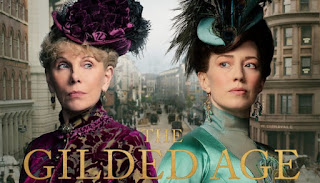
"Here We Are, All of Us Together" - The Gilded Age (Season Finale)


The Gilded Age: A Tale of Today was the title of an 1873 satirical novel by Mark Twain and Charles Dudley Warner (Twain's only co-authored novel). That novel satirized greed and corruption in post-Civil War American society. Its title has since became synonymous with the last quarter of the 19th-century in the United States and the greedy, materialistically stratified society and corrupt public life widely recognized as characteristic of that particular period. The Gilded Age is now also famously the title of the successful HBO series, supposedly set in New York in 1882 and created by Julian Fellowes (of Downton Abbey fame). I wrote about the series' first episode earlier, at: 

https://www.blogger.com/blog/post/edit/1538477881080991285/1711702638689996921?hl=en

Eight episodes later, The Gilded Age has lived up to the promise implicit in any costume drama "period-piece" of highlighting what was attractive in such previous eras - lavish lifestyles, beautiful clothes, and good manners (the latter two being especially notably lacking and rightly missed today).

In the season finale, George Russell having dramatically overcome two significant challenges to his financial and political power, Bertha Russell likewise succeeds in her over-the-top social ambitions. Gladys gets her ball at last and is now "out," but the ball was as much Bertha's ball as hers, her moment of triumph standing at long last next to Mrs. Astor, with Ward McAllister intoning, "Here we are, all of us together."

Less happily, Marion's heartbreak, which in retrospect was probably predictable, highlights the emotional toll of all this social stratification. But Marion seems primed to get over Tom, and (as watchers have likely long suspected) Larry (another Australian actor!) is at the ready to replace him, and is obviously a much more suitable substitute. 

All's well that ends well - except perhaps for Peggy and her already fractured family, devastated by the discovery that her baby boy is alive.

The Gilded Age successfully recreates the social whirl and mores of late 129th-century New York high society in all its charming politesse and its roots in rapacious capitalist greed.

Five years after the supposed date of the HBO series, Edward Bellamy wrote another Gilded Age themed novel, Looking Backward, set in the year 2000 and (as an alternative to the greedy, materialistically stratified society and the corrupt public life of the Gilded Age) portraying a utopian, quasi-socialist society, in which the distinction between rich and poor has effectively been overcome and in which everyone under 45 must work (but only four days a week with lots of leisure time for high-brow pursuits). That pivotal year 2000 has come and gone, and we find ourselves nowhere near Bellamy's anti-gilded Age utopia. Instead, we are rapidly regressing back to the worst aspects of Gilded Age inequality and greed, without any of the benefits of high-minded leisure pursuits, let alone beautiful clothes and good manners!

Monday, March 21, 2022

The Complex Clarity of Civilizational Conflict


Back in 1992, in the absurdly optimistic interval that followed the unexpectedly sudden collapse of the Soviet Union and the de facto end of the Cold War, Francis Fukuyama famously wrote The End of History and the Last Man, which argued, in a rather Hegelian way, that history had run its course and reached its final form. This resonated with the then increasingly widely held (even if erroneous) belief that the only remaining alternative for nations in the post–Cold War world would be some version of American or European capitalist, liberal democracy. In contrast, others argued that, after the aberration of the Cold War, world politics and international relations would revert to something like the traditional, normal, non-ideological, interest-based conflicts between nation-states.  Meanwhile, borrowing a phrase already used by Albert Camus, Bernard Lewis, and others,  Samuel Huntington wrote about a "clash of civilizations" (which became the title first of a 1993 Foreign affairs article and then a 1996 book The Clash of Civilizations and the Remaking of World Order). Huntington's analysis controversially hypothesized a world of several competing cultural identities or civilizations rivaling one another in a new post-colonial world. Contrary to the ideology of secularization still so dominant intellectually, Huntington hypothesized how cultural and religious identities would increasingly shape post-cold War conflicts. His argument reflected (and benefited from), for example, what was being experienced in Europe after the breakup of Yugoslavia and even before that the islamic Revolution in Iran. While limited in its applicability and problematic in some of its assumptions, this theory of increasing civilizational conflict did serve as a sort of counter to the Western-centric civilizational ideology that asserted the inherent universality American and European political and economic values, implicitly minimizing the popularity and resilience of other cultural models.

My own thinking has largely been a pragmatic variation on a realist model, which starts with the existence of modern nation-states with specific geopolitical interests, but one which recognizes that ideological and cultural factors and religious and moral values play an important part in a nation's self-understanding and become, in effect, a real dimension of its "interests." Thus, during the Cold War, one did not need to start from communist ideology to understand the Soviet Union's policy in guaranteeing for itself a sphere of influence in Eastern Europe. Russia having been many times invaded from the West, most recently in the 19th century by Napoleon and in the 20th century twice by Germany, it was easy to understand the Soviet Union's security interest in controlling eastern Europe and its motivation in maintaining the division of Germany and a strong Soviet presence in what became the Warsaw pact. On the other hand, the "Finlandization" solution was confined to Finland and Austria, while explicitly communist governments and the ideological apparatus that accompanied communism were imposed on those other Warsaw pact countries. And there can be no doubt that the way both Stalin and subsequent Soviet leaders looked at and interpreted U.S. and NATO behavior was intensely colored both by traditional imperial and Orthodox Russian distrust of the "Latin" West and a distinctive Marxist-Leninist interpretation of the motivation and behavior of capitalist states. If that last factor is less salient now, it may still survive subconsciously among leaders like Putin who were socialized under Marxist-Leninist ideology, while the more traditional imperial and older Orthodox distrust of the West may be even more salient now that it is no longer ideologically subordinated to communism.

All of this is, I think, relevant to understanding the current conflict between Russia and Ukraine, which remains rooted in a certain Russian interpretation of its national interests within the modern nation-state system, clearly colored by and filtered through its inherited imperial and Orthodox cultural self-understanding and interpretation of the outside world.

Meanwhile, while it is certainly true that Ukrainian national resistance and NATO support for Ukraine can be explained in part in realist terms, that is a limited understanding of the revived appreciation of the perennial cultural conflict between Russia and the West. (Remember Tocqueville!)

It was NATO more than the EU, and the Cold War need for common defense against Soviet expansion more than the shared experience of capitalist, liberal democracy that held the western alliance together so effectively while the Soviet Union was still a real threat. The rapid loss of common civilizational clarity among Western societies, both in North American and Europe, after the end of the Cold War was obviously a reflection of that. Now that the threat is somewhat more clear again, the Western world seems to be recovering (at least for a time) some of tis civilizational clarity. That China, India, and the Muslim nations seem relatively reluctant to get on board likewise reflects not just those countries' different geopolitical situations, but the different cultural and philosophical filters through which they interpret themselves and the world.

Western civilization predates capitalist, liberal democracy and includes a complex of cultural and moral values and religious interpretations, some of which compete with rather than reinforce capitalism and liberal democracy, but which nonetheless remain significant still. That said, all those occasionally competing components have come to coexist within a successful Western paradigm of political pluralism which Russian history leaves little room for, in contrast to Ukraine's historically more Western orientation.

So one collateral consequence of this horribly tragic war may be a healthy renewal of Western nations' shared self-understanding in all its varied complexity - less as a mission to impose capitalist, liberal democracy on others who may not presently want it and more as a renewed appreciation of the abiding strength found in the historical evolution of Western European and American political and cultural values, which recent circumstances have conspired to undermine at home as well as abroad. 


Слава Україні!

(Glory to Ukraine!)