Wednesday, December 22, 2021

A Blessing in the Shadow of Death


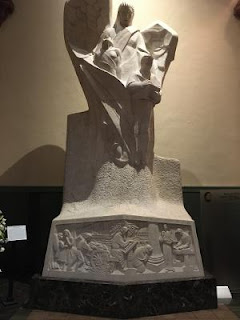
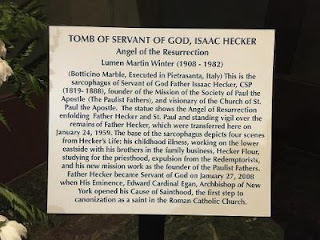
Servant of God Isaac Hecker, the founder of the Paulist Fathers, died on this date in 1888, at age 69.

Hecker's final illness had intensely focused him on the one most important thing – his relationship with God – ultimately a greater and more important thing than anything one does in life. In sentiments that somewhat recall those of Saint Thomas Aquinas shortly before his death, Hecker expressed his own experience: "There was once a priest who had been very active for God, until at last God gave him a knowledge of the Divine Majesty. After seeing the majesty of God that priest felt very strange and was much humbled, and knew how little a thing he was in comparison with God.In his final years, Hecker lived what one of his favorite spiritual authors, Jean-Pierre de Caussade (1675-1751), called “the sacrament of the present moment.” Caussade had written: “To be satisfied with the present moment is to relish and adore the divine will moving through all we have to do and suffer as events crowd in upon us.”
 
In his eulogy at Hecker's funeral, the Jesuit Provincial recounted the scene at Hecker’s deathbed, when his fellow Paulists asked him for his final blessing. Hecker "roused himself from the depth of pain and exhaustion, and his ashen lips which death was sealing pronounced the singular words … “I will give it in the shadow of death.” His feeble hands were raised, and like a soldier dying on the field of battle he reconsecrated his followers in the name of the Father, Son, and Holy Ghost for the struggle in which they had chosen him as Leader."
 
Eulogizing Hecker after his death, Bishop John J. Keane (1839-1918) wrote: "He has planted germs of thought, of aspiration, of life-purpose in many and many a soul, in every rank of the church, in every corner of our country; and they will go on fructifying, to his honor, as well as for the glory of God and the welfare of the world."
 
Animated by an increasingly conscious appreciation of God’s Providence, Hecker had opened himself to be guided by the Holy Spirit, whose presence and action he discerned in God’s care for him, and through that experience he had recognized the grace to attach himself to the Roman Catholic Church for the rest of his life. Himself a product of the religious fragmentation of American society, but drawn by God’s providential grace to seek the light of truth and find it in the unity of the Catholic Church, he then committed himself completely to share what he had found with others similarly inspired to seek and to find, and to whom his story continues to speak. All his diverse pastoral and missionary efforts and accomplishments would remain rooted in his abiding trust in God’s presence and action in his own life and in the world in which he lived. His conversion was complete, and his spirituality was generously and determinedly evangelizing – expressing a prayerful, lifelong, intimate dedication to and cooperation with God’s design for human beings.
 
His enthusiastic embrace of the Church led him to an active vocation as a priest and religious, giving his all to cooperate with God’s grace in serving God, the Church, and his contemporaries. His difficulties as a student had helped him to discern that his own sanctification and whatever efforts he might in time expend for the salvation of his fellow-Americans would themselves be products of God’s grace, according to the means God gave him.
 
Thus formed by Providence through the crucible of contradictory experience, Hecker lived a consecrated life of priestly mission as a parish pastor, a preacher of missions, a public speaker lecturing to Catholic and non-Catholic audiences, an author and apologist, and the founder of a religious community, which, as a canonically approved clerical Society of Apostolic Life in the contemporary Church, continues his charism “to be a dwelling place for the Holy Spirit and a prophetic instrument for His sanctifying action.” 
  
Finally, he  surrendered himself and all his activities to the call to conform his life to the mystery of Christ’s Cross – filling up, in the words of his patron, Saint Paul, what is lacking in the afflictions of Christ, on behalf of his body, which is the church (Colossians 1:24).
 
Through it all, Hecker lived a life of recognizable holiness. His reputation for sanctity was evident in his own lifetime and has continued to inspire pastoral and missionary zeal in the Church down to today. Summarizing Hecker’s legacy, one of his 20th-century successors as Superior General of the Paulist Fathers, Joseph McSorley (1874-1963), wrote that Hecker manifested “a magnetic power commonly associated with personal holiness.”
 
In his life as a Catholic convert and a priest, Isaac Hecker practiced the theological and moral virtues to an heroic degree, confident that he was “living and working in the dawn of light of an approaching, brighter, more glorious future for God’s Holy Church."


Tuesday, December 21, 2021

Solstice


In our Northern Hemisphere, 11:59 a.m. today marks the winter solstice - the day when the North Pole reaches its maximum tilt away from the sun, when the sun seems at its lowest in the sky, the day with the shortest length of daylight and longest night of the year in the northern hemisphere. Historically, it is no accident that we do not celebrate Christmas in June when the sun is high and the days are long, but rather now when the world is at its darkest and the light seems so precious a gift from above.

Given the widespread displacement of the Christmas Liturgy to Christmas Eve and the understandable appeal and popularity of "candlelight" Christmas services, one could be forgiven for forgetting that the liturgical symbolism of Christmas is connected not with celebrating darkness but is rather a celebration of light - the light of Christ coming to illuminate our sinful world just as the "the unconquered sun" conquers winter's darkness.

Whether or not Christmas was explicitly assigned to its date in order to correspond to the Roman dies natalis solis invicti, the theme of the light illuminating darkness has always been central to the traditional imagery of Christmas. Thus, the Introit for the traditional second (Dawn) Mass of Christmas began Lux fulgebit hodie super nos ("A light will shine upon us this day" - Isaiah 9:2), while the Alleluia verse for the traditional principal Christmas Mass (during the day) proclaimed quia hodie descendit lux magna super terram ("for this day a great light has descended upon the earth").

The light is indeed coming, but it comes to us who are in the dark. Hence the abiding beauty of this winter season and its imagery, expressed, for example, in this familiar poem and carol.


In the Bleak Midwinter, by Christina Rosetti (1830-1894)

In the bleak mid-winter
Frosty wind made moan;
Earth stood hard as iron,
Water like a stone;
Snow had fallen, snow on snow,
Snow on snow,
In the bleak mid-winter
Long ago.

Our God, heaven cannot hold Him
Nor earth sustain,
Heaven and earth shall flee away
When He comes to reign:
In the bleak mid-winter
A stable-place sufficed
The Lord God Almighty —
Jesus Christ.

Enough for Him, whom cherubim
Worship night and day,
A breastful of milk
And a mangerful of hay;
Enough for Him, whom Angels
Fall down before,
The ox and ass and camel
Which adore.
Angels and Archangels
May have gathered there,
Cherubim and seraphim
Thronged the air;
But only His Mother
In her maiden bliss
Worshipped the Beloved
With a kiss.

What can I give Him,
Poor as I am? —
If I were a Shepherd
I would bring a lamb;
If I were a Wise Man
I would do my part, —
Yet what I can I give Him, —
Give my heart.
Photo: In the Bleak Midwinter, as first published in Scribner's Monthly (January 1972) 


Monday, December 20, 2021

Advent with Alfred Delp (Week 4)


We no longer hear Luke's great account of the beginning of John the Baptist's public ministry on the 4th Sunday of Advent, as was the case for so many centuries and was still so in Alfred Delp's day. That) particular pericope is particularly famous for its list of some of the relevant political power of the day, beginning with the Emperor, presumably to situate the Gospel story int he specifics and particularity of its human time and place. At the same time, it offers an alternative to the claims of salvation through politics - a message obviously of particular relevance on 1940s Germany, but also of special relevance here and now. As David French wrote just yesterday, reacting to yet more statistics on the subject of religious disaffiliation especially among those without college degrees: "I suggest that our nation’s increasing political zeal is fundamentally misplaced? Could I suggest that as religious and civic engagement declines, too many Americans are replacing religion with politics, and the false god of politics does not present the answer for what ails our hurting nation?" ("The Wounds Politics Cannot Heal" - https://frenchpress.thedispatch.com/p/the-wounds-politics-cannot-heal?token=eyJ1c2VyX2lkIjoxMTYxOTMxNSwicG9zdF9pZCI6NDU3MDI0NTcsIl8iOiI2cTdDdyIsImlhdCI6MTYzOTkyMjUzOSwiZXhwIjoxNjM5OTI2MTM5LCJpc3MiOiJwdWItMjE3NjUiLCJzdWIiOiJwb3N0LXJlYWN0aW9uIn0.UBHZ0xXa0Xe7izXvfrLt2P-d4jxT1rJSQM-RmA7yhfI ).

For Fr. Delp, preaching in Munich in 1941, this final week of Advent represented "a fourth call to mankind, to our very being. ... a call to bring reality into the order it should be in, if we want to meet the Lord and if we really are practicing Advent—which means being under way, seeking, and waiting." He contrasted the figure of John the Baptist with his contemporaries who sought "to build temples to the divine emperor," and with Pontius Pilate, "the man who had only one priority in his life: to remain a friend of Caesar," with the other pagan powers of the day, and with the ruling religious establishment in Jerusalem (also mentioned by Luke), who showed "not only was there no hope from worldly power, the holy place was also sold out."

"Think of it," asked Fr. Delp: "Tiberius, Pontius Pilate, Herod, Philip, Lysanias, Annas, Caiaphas. When was there a more hopeless hour?" Was her perhaps suggesting a similar unease about his own, hardly hope-filled 1941 Europe? How might we hear this in our own morally challenged political and religious time?
 
Preaching in Munich again a year later, Fr. Delp challenged his wartime (and perhaps war-wary) congregation against "concealing Christmas behind bourgeois customs and sentimentality, behind all those traditions that make this holiday dear and precious to us." In a message every bit as timely now as then, he asked his hearers to recognize in this holiday celebration "the founding of a final order for the world, a new center of meaning for all existence. We are not celebrating some children’s holiday, but rather the fact that God has spoken His ultimate Word to the world. Christ is the ultimate Word of God to the world."

Two years later, meditating while imprisoned in Berlin on this final Advent Sunday, which was to prove to be his last, he again recalled this historical context highlighted by Luke's Gospel, which "enumerates the power brokers who determined the structure of the small sphere where the light was about to appear and salvation would be proclaimed." He recalled "a hopeless moment in history is signaled here. It was hopeless from Caesar’s throne all the way down to the guards of the temple sanctuary." Yet, "while history was so hopeless and unspiritual all the way into the sanctuary of the Lord, then the Word of the Lord came to John."


Sunday, December 19, 2021

Visiting Us


After the horrible hiatus of the covid pandemic and despite its continuing dangers, this week once again many people all over America and the world will be visiting family or friends for Christmas. For, whatever else is happening, this is, as that great 19th-century fan of Christmas, Charles Dickens, delightfully described it: “a good time; a kind, forgiving, charitable, pleasant time; the only time … on the long calendar of the year, when men and women seem by one consent to open their shut-up hearts freely.” So what more fitting Gospel account for this final Sunday before Christmas than the forever familiar story of Mary’s family visit to Elizabeth?

On the other hand, as we all well know, holiday visits are not always what we would like them to be – whether for the visitors themselves or for the ones being visited. It’s hard sometimes to show affection when affection is not so fully felt, or – especially in this period of intense political polarization and division - to come up with the right words that won’t cause or exacerbate conflict! Sometimes, opening our “shut-up hearts” may be difficult, undertaken only grudgingly – more a matter of duty than desire – or, more likely some confusing combination of the two. How fitting, then, to hear today about a visit by one person whose motives, we know, were never mixed! 

The traditional site of Zechariah and Elizabeth’s home and so the presumed site of the Visitation is the little town of Ain Karim, some 5 miles west of Jerusalem – a journey at that time of several days from Galilee through Samaria to Judea. Obviously, we cannot know now exactly what Mary may have felt as she undertook that difficult journey, in response to God’s plan that had been revealed to her by an angel. The story says she set out in haste. No procrastination, no putting off what, to our “shut-up hearts,” might seem merely a dutiful but burdensome social obligation. Perhaps, she sought to draw on the wisdom and strength of her older relative. Surely, she must have wanted to make contact (in a world without Facebook and Twitter) with the only other person who had thus far been let in on God’s great plan, that was even then quite literally taking shape in the bodies of these two remarkable women.

After so long, Elizabeth in her old age had also conceived a son - and had responded to this incredible favor by going into seclusion. Also unexpectedly pregnant, Mary responded to this problematic and potentially dangerous development differently - by rushing off to visit Elizabeth.

Instead of shouting her good news to the world (which until then had reproached her for being childless), Elizabeth waited silently for the miracle’s full meaning to make itself known. Instead of cautiously keeping quiet, Mary rushed to tell all to Elizabeth, thus showing her own complete confidence in the God who had totally taken over her life.

What a wonderful story, this episode in the greatest story ever heard, this story that every year at this time demonstrates its incredible capacity to command our attention and touch us where we feel it most deeply!  Every year, despite all the tragedies and difficulties that get in the way, all sorts of people, all over the world, with different personalities and preoccupations, different needs and wants, different fears and hopes, hear the Christmas story and are captivated by it - for it speaks directly to each one of us, reviving our capacity to believe and our willingness to hope.

Back in 5th-century Christian North Africa, one of the great Doctors of the Church, St. Augustine, said: “If God’s Word had not become flesh and had not dwelt among us, we would have had to believe that there was no connection between God and humanity, and we would have been in despair.”

That is what the Christmas story is all about – a chance not to despair, an incentive to hope. The God for whom Elizabeth silently waited for so long, the God whom Mary carried in her womb so faithfully, has come at last to live with us. In the process, he connects us not only with him but with one another. As he brought Mary and Elizabeth together, filled with the Holy Spirit, so he leads us to one another and unites us, thought the same Holy Spirit, in a new community, formed by faith, directed by hope, and alive with love. And we, as a result, must never let things be the same again!

And they won’t be - and we won’t have reason to despair ever again - if, like Elizabeth, when we hear him coming, we offer him the hospitality of our hearts, and if, like Mary, having conceived him in our hearts, we are willing to carry him into the world with confidence – so that, through each of our no longer “shut up” but now wide open hearts, Christ can truly be our hope and become so for all the world.

Homily for the 4th Sunday of Advent, Saint Paul the Apostle Church, New York, December 19, 2021.

Photo: Domenico Ghirlandaio (1449-1494) The Visitation, Fresco, Cappella Tornabuoni, Santa Maria Novella, Florence.

Saturday, December 18, 2021

"Ernest the Seeker"


Servant of God Isaac Hecker was born, here in New York City, 202 years ago today, on December 18, 1819. Like so many New Yorkers, now as then, Isaac was the son of immigrant parents. And, like an increasing number of young Americans now, he apparently received little formal religious instruction in his youth. Such at least was his claim in an account of his life, which he wrote in Rome in 1858, a state of affairs he characterized as typical in the United States at that time. 
 
With or without formal religious instruction, however, Hecker grew up in a society still Christian in its ambience and in its publicly professed morality. Moreover, it is at least likely that he attended at least some Sunday services with his devout Methodist mother. Methodism was then the largest religious group in the country. It was also, in George McKenna's words, “a religion of the upward aspiring at a time when ‘self improvement’ was itself almost a religion.” And, from an early age, Hecker had internalized a belief in God’s special providence – that God had a providential plan for his life. (This is reflected in the first of the six images at the base of Fr. Hecker’s sarcophagus in Saint Paul the Apostle Church in New York City, which shows Isaac as a sick child, in danger of death from smallpox, reassuring his mother: “No, mother, I shall not die now; God has work for me to do in the world, and I shall live to do it.”)
 
Hecker briefly attended a local New York City Public School, but his formal education ended early when as many of his contemporaries he needed to go to work. (His limited education, however, hardly suggested the profundity of his future thinking.) Meanwhile, his father’s failure to provide for his family had effectively transferred that responsibility to Isaac’s two older brothers, John and George, who became bakers and eventually owned four shops and their own flour mill. Isaac joined his brothers as baker and delivery boy. (Thus, the second image at the base of Hecker’s sarcophagus shows him as a young man along the Hudson River wharves delivering bread from his brothers’ bakery.)   
 
Even then, however, Hecker was asking big picture questions about the direction of his life. "What does God desire from me? What shall I attain unto Him? What is it He has sent me into the world to do?" Fortunately, “Hecker and Brothers, Makers of Hecker Flour” had become a successful, quite prosperous business, and the Hecker brothers became sufficiently wealthy to be able to support Isaac in his increasing attention to his spiritual search.
 
The Hecker brothers were also very actively involved in Jacksonian-era New York Democratic Party politics, and John Hecker was one of the leaders of the Locofocos, a pro-reform faction. In his 1858 narrative of his life, Isaac recalled how he initially viewed political reform as "the remedy for existing evils and of rendering mankind happy.Isaac remained committed to the ideals of Jacksonian democracy even after American politics had long since evolved beyond that, but his priorities quickly evolved from political to social to religious concerns. 

This was, after all, the era known as the "Second Great Awakening." Hecker took time examining his religious options, sampling as many as possible of the leading contemporary religious ideas, none of which, however, answered the demands of his reason or proved satisfactory to his conscience - until, as he put it, "The Catholic Church burst upon my vision as the object to which all my efforts had been unintentionally directed. It was not a change, but a sudden realization of all that had hitherto obscurely captivated my mind, and secretly attracted my heart". In thus describing his spiritual quest and its seemingly surprising outcome, Hecker wanted to emphasize what would become his lifelong conviction that Catholicism was consistent with and indeed the true fulfillment of the aspirations of human nature – a 19th century version of the theme of St. Augustine’s Confessions: “You have made us for yourself, O Lord, and our heart is restless until it rests in you.
 
En route to finding his home in the Catholic church, Hecker had come under the influence of Orestes Brownson (1803-1876), and Brownson's emphasis on the social dimension of religion. When Hecker first heard Brownson lecture in New York in early 1841, he was a prominent Unitarian minister, journalist, and active social reformer. Hecker and Brownson would soon become perhaps the two most influential 19th century American converts to Catholicism. 
 
The third image at the base of Hecker’s sarcophagus shows him searching for God at Brook Farm – a transcendentalist, utopian community, founded in West Roxbury, Massachusetts by Brownson’s friend George Ripley in 1841. New England Transcendentalism had its roots in the Unitarian rejection of classical Calvinist doctrine and orthodox Christianity in general – what Hecker later characterized as “a gradual loosening of the Christian principles in men’s minds and a falling away into general scepticism.” 

A smart, if relatively uneducated, working-class young man, Hecker was excited to enter this elite community and participate in its intellectual life. This transcendentalist environment was quite conducive to Hecker’s intense preoccupation with exploring his inner life, and his companions nicknamed him “Ernest the Seeker,” the name of a character in a contemporary short story by William Henry Channing. Hecker certainly absorbed the Transcendentalists’ critique of mainline New England Protestantism. “Against Calvinism we had a particular grudge,” he later recalled.” To the end, he would critique “the Calvinistic error that nature and man are totally corrupt.”
 
Yet, while benefiting from an environment that encouraged him to value and explore his inner life, Hecker - in part, perhaps, because of the class difference - consistently maintained a certain intellectual independence from the beliefs of the Transcendentalists, thus enabling his exploration of his soul to lead to conclusions quite different from what the Transcendentalists believed. “I don’t know,” he wrote in 1843, “but that I will be unable to become one of the Community. In their life it is clear that they commune with different kind of objects from what I do.”
 
As he came to understand his inner spiritual experience in terms of the action of the Holy Spirit, he found himself more and more drawn to institutional Christianity. His early identification of Divine Providence with the indwelling Holy Spirit made theological sense of the continuity between nature and grace, which he felt from his own experience, thus easing his way into the Church and laying the groundwork for his mature thought about the relationship between Church and society and the evangelization of the latter by the former.
 
As Hecker continued his inner exploration and comparative study of different churches, he studied the Catechism of the Council of Trent (The Roman Catechism) and was especially impressed by Article IX on the doctrine of the communion of saints. Writing in the Paulist magazine, The Catholic World, one year before his death, Hecker recalled:
 
"When, in 1843, I first read in the catechism of the Council of Trent the doctrine of the communion of saints, it went right home. It alone was to me a heavier weight on the Catholic side of the scales than the best historical argument which could be presented. … The certainty of the distinctively Catholic doctrine of the union of God and men made the institution of the church by Christ exceedingly probable.                                                                                                  
Finally, he was received into into the Roman Catholic Church at New York's original Saint Patrick's Cathedral on August 1, 1844. Subsequently, he and his brother George, who had followed Isaac into the Church, were both confirmed on May 18, 1845.
 
Like Christian history’s most famous seeker, Saint Augustine, Hecker had examined the leading intellectual and religious currents of his time, paying intense attention to his own inner spiritual sensibility, before finally finding a permanent home in the Roman Catholic Church. In our contemporary idiom, Hecker was “spiritual but not religious” for much of the first 25 years of his life. The very personal story of his spiritual search, of his intense attention to his own inner spiritual sense, eloquently exemplifies the perennially human appeal of such a spiritual search and certainly speaks to the spiritual longings of some in our own (admittedly more secular) society today. What was significant about Hecker’s “spiritual but not religious” period, however, was that he did not remain that way. For Hecker, seeking was never an end in itself. The point of seeking was finding. Once the object was found, the search ended. Having found fulfillment in the Catholic Church, he never desired to look farther. Rather, he desired to devote his life to helping others – especially other seekers, such as he himself had been – to find the truth in the Catholic Church. Hecker’s enthusiasm for his new faith and his commitment to the Church would permeate all his subsequent activities – from his initial conversion experience as recorded in his Diary, through his active ministry as a priest and missionary preacher, to his final mature exposition in his last book, The Church and the Age.

In this first phase of his life, Hecker, animated by an increasingly conscious appreciation of God’s Providence, had opened himself to be guided by the Holy Spirit, whose presence and action he discerned in God’s care for him, and through that experience he recognized the grace to attach himself to the Roman Catholic Church for the rest of his life. Himself a product of the religious fragmentation of American society, but drawn by God’s providential grace to seek the light of truth and find it in the unity of the Catholic Church, he then committed himself completely to share what he had found with others similarly inspired to seek and to find, and to whom his story continues to speak. All his diverse pastoral and missionary efforts and accomplishments would remain rooted in his abiding trust in God’s presence and action in his own life and in the world in which he lived. His conversion was complete, and his spirituality was generously and determinedly evangelizing – expressing a prayerful, lifelong, intimate dedication to and cooperation with God’s design for human beings.


Reflecting upon his experience many years later, Hecker wrote that he “not only became a most firm believer in the mysteries of the Christian religion, but a priest and a religious, hopes thus to die.”