Thursday, January 20, 2022

One Year In


Early in 1978, I and a couple of my academic colleagues on the political science faculty at the university where we were teaching staged a panel discussion on President Jimmy Carter's just completed first year in office. It was essentially an excuse for us to play pundits for the edification or entertainment of our undergraduate students. I don't think any of us then thought of the one-year anniversary as much more than a convenient occasion for commentary. Politics was already changing, but it was still very different then from what it has since become, and it was still comprehensible in the conventional ways we then understood. 

Part of that then still conventional understanding was that first-term presidents typically take up to two years to get up to speed and that the third year is, therefore, often the most productive (before the distraction of the next presidential campaign takes over in the fourth year). Of course, politics is completely different now. Campaigning is constant, and politicking rather than policy-making is increasingly the main frame of reference through which the media interprets political life. Congress is increasingly less a partner in policy-maklng and more a forum for political posturing, making it more an obstacle to the president's agenda than was once routinely the case. The permanent campaign precludes any presidential "honeymoon," while the looming prospect of losing congress to the opposition party in the mid-term election (as happened to both Obama and Trump) makes the first year the only year in which enacting the president's agenda through legislation is a realistic hope.

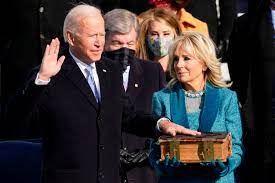
So, in this deformed political context, where does President Biden stand at this critical juncture one year in? His standing in the polls at this point is lower than that of most recent presidents (Trump excepted), and media coverage (which is what the polls reflect and reinforce) has been increasingly negative. Punditry presumes a certain sort of historical determinism, in its expectations about the midterms, which may well prove true, but less because of historical inevitability and more because of the Democrats' demonstrated political failures.

Some of that is the fault of the Administration's own messaging. After all, the Biden Administration did get a major covid relief bill passed and its infrastructure bill passed, accomplishments worth bragging about. Instead, however, it has pursued a much more ambitious agenda, which may well reflect the preference of many (maybe most) Americans, but which always had little chance of success in our unrepresentative, inherently antidemocratic Congress. Perhaps those policy goals should have been pursued anyway and maybe could have been pursued more successfully in a more moderate manner. But two unexpected developments just prior to Biden's inaugural made that strategy less likely.

When Biden won the election in November 2020, it was evident that Democrats would retain only a modest majority in the House, and it was widely expected that they would remain the minority in the Senate. The peculiar dysfunctions then at work within the Republican party provided an unexpected opportunity to win not just one but both Georgia Senate seats in the January 5 run-off election. This surprise created an evenly divided Senate, with Democrats in procedural control thanks to the Vice President's tie-breaking vote. This made it possible to imagine improbable legislative outcomes, which would have been completely impossible to expect prior to January 5. To this exaggerated expectation of a path to a more transformative presidency (as if Biden were a new FDR or LBJ, both of whom, of course, had enormous, not razor-thin, congressional majorities) was added the inevitable reaction against the January 6 insurrection attempt. 

Yet it became clear fairly quickly that there were limits to what this very narrow congressional majority could actually be counted on to accomplish. The disgraceful behavior of Senators Manchin and Sinema has been the ongoing media soap-opera, into which the Biden Administration has allowed itself to be trapped. In fact, however, both senators had been fairly clear all year about where they stood. Persuading them to vote to end or modify the filibuster may be an honorable goal, but it was always unlikely to succeed. So, other than reinforcing the loyalty of the Democratic party base, the constant struggle to pass what had no real hope of being passed, has only made the Biden Administration and the Democrats look like ineffective losers (in spite of the major bills that were successfully passed but were largely ignored instead of bragged about).

While the FDR/LBJ analogy is irrelevant in any case because they had such large majorities (which /Biden lacks), there is another reason why the analogy fails. The model of American politics that FDR and LBJ practiced was famously a politics of persuasion. Both understood the need to persuade others, and both were very good at it. How good at it Biden might be in their circumstances is pure speculation. There is at present practically no one to persuade. Biden's Mitch McConnell is not LBJ's Everett Dirksen. Republicans are largely united in their commitment to oppose Biden simply for the sake of opposing. Likewise, someone like Senator Manchin is largely. impervious to persuasion as a conservative Democrat in a radically Republican state.

If it is still true that presidential power is the power to persuade, the object of persuasion is no longer Congress but the public (in large part filtered through the media), who must somehow be persuaded to evaluate the President and his party differently from how politicians and pundits do. Biden may yet do this (and hopefully will be able to do so before the midterm and a fortiori before the 2024 election), but he has no successfully done so as yet. Democrats must also cure themselves of their fatal obsession with the presidency and rediscover how to build up their party base at all levels of government - especially at the local and state levels - and in a larger area of the country.

The midterms are still many months away, and a possible Biden-Trump rematch is still years away. That is an eternity in politics. So much may happen between now and then, including the completely unanticipated (as was covid at the beginning of 2020). How the present pandemic will play itself out remains to be seen. No one saw omicron on the horizon last fall when we were all anticipating an imminent end to the pandemic. More problematically, the Biden team did not anticipate wither the extent of Republican opposition to the covid vaccine or the resulting need to continue mass testing. But the Democrats could have avoided (or at least prudently retreated from) being identified, for example, as the party of closed schools - a policy pursued by some teachers' unions (an excessively powerful part of the Democratic coalition) but not welcomed by parents and demonstrably damaging to students.

Meanwhile, assuming we can attain a satisfactory modus vivendi with covid, Biden's problem will be the perennial problem for contemporary Democratic presidents - persuading ordinary voters that the Christmas tree of social benefits Democrats are attempting to provide for them matter more than the cultural grievances and racial resentments which Republicans are all about exploiting in order to keep the country conflicted and divided to the greater advantage of the richest among us.

Monday, January 17, 2022

Eight Days in May (The Book)


There seems to be no end in sight to our fascination with World Wr II - certainly not to my fascination with it. Hence, I spent some of this holiday weekend with Eight Days in May: the Final Collapse of the Third Reich, by Volker Ullrich, tr. Jefferson Chase. As its title suggests, this is a day-by-day account of the eight days (May 1-8, 1945) between Hitler's suicide on April 30 and V-E Day and the reenactment in Berlin on May 9 of Germany's already accomplished surrender in order to satisfy Stalin's vanity (definitely a harbinger of conflicts to come).

That alone would make an interesting book. But this eight-day journey includes retrospective and prospective accounts, contributing a more complete context than would be possible in a strict eight-day chronology. Still, between Hitler's cowardly exit and the jubilation of V-E Day, a surprising amount happened. Unlike the dramatic cessation of conflict on the Western Front at the end of World War I, the end of the Second World War was spread out over time, with complete chaos (dramatically portrayed by the author) in significant parts of the Reich while at the same time and somewhat confusingly the German occupation persisted intact until the final moment in Scandinavia and parts of the Netherlands and Czechoslovakia. Meanwhile, the rump Reich government, led from Flensburg by Hitler's "successor," Admiral Karl Dönitz, continued to pretend to operate even after it had performed its one essential function of unconditional surrender.

Ullrich characterizes this unique week as a kind of historical pause "the gap between no longer and not yet," and amazingly appropriate formulation.
 
From a distance now of more than 76 years, it is a challenge for those of us who obviously have no memory of those dramatic events to appreciate all that happened - from the fanatical last stands of the defeated, to the final deaths and lucky survivals of the many civilian victims, to the complex maneuvers of the victors. Ullrich supplies those recollections for us with copious detail.

At some point, the fascination with World War II will wane. But that will be a loss for the world. As Thomas Merton once wrote: 'What a tragedy to forget Hitler and Stalin and their total corruption of the moral sense" [May 7, 1961, Journals, volume 4, p. 116].

Thursday, January 13, 2022

Wildland: the Making of America's Fury (The Book)


Journalist Evan Osnos writes for The New Yorker and is a fellow at Brookings. Before that, however, he spent a decade reporting first from the Middle East and then from China. (His first book Age of Ambition: Chasing Fortune, Truth, and Faith, in the New China won the National Book award in 2014). In 2013, he and his wife returned from China, and he set out to investigate how America had changed in the 21st century. There are many books - many good books - about the Trump era, but Osnos' analysis stands out precisely for his highly personal approach, which focuses primarily on people in three particular locations - wealthy Greenwich, Connecticut, where Osnos grew up, Clarksburg, West Virginia, a small but once thriving Appalachian industrial town where he worked his first newspaper job, and Chicago, Illinois, where he became a foreign correspondent for the Chicago Tribune

Wildland: The Making of America's Fury (Farrar, Straus and Giroux, 2021) presents Trump's presidency less as the primary cause of our deep national divide but rather as the fruit of developing divisions into separate and significantly unequal components. In many ways the beating heart of his account is the stories of characters encountered along the way who personify what has happened to America in this century. There are parallels in the experiences of the characters, all of whom in varying ways embody some element of isolation from the larger society, but also radical difference due to our increasing economic inequality and America's perennial problem of racial disparities.

On a macro-level, this is an account (another account) of how wealthy Americans have used the system to advance themselves at the expense of society, and of the failures and complicities of our supposedly democratic political system - the same system that empowered Republican senators representing a mere 14.5% of the country's population to acquit the impeached President Trump. With an acute appreciation of immediate relevance (aided by his familiarity with West Virginia), he highlights the problem posed by someone like Senator Joe Manchin, who famously shot at climate-change legislation in a campaign ad when he ran for the Senate in 2010. "For decades, politicians had been photographed with guns, but this was the first time anyone had assassinated a piece of proposed legislation on film."

Literarily, the book is a treasury of memorable phrases describing an America "losing a habit of mind, a capacity to envision a common good." Trump's fans are "a confederacy of the frustrated - less a constituency than a loose alliance of citizens who were breaking faith with the institutions of American politics and economics." Trump's "ideas were riven by contradiction ... yet that was a reflection of voters' often incoherent sets of convictions." Trump "mastered the national iconography of politics and divorced it from the actual conditions on the ground." Trump's rise was less "a hostile takeover," than "a joint venture, in which members of America's elite accepted the terms of Trumpism as the price of power." Trump "exposed the personal ambition that drove so many in Washington." Then came the pandemic "revealing the full scope of America's institutional disrepair - the cruelties of the economy, the disparities of systemic racism, the skittering, malleable minds of a public trained to doubt the 'body of fact'." The country's failure to confront the pandemic was "a malfunction of elite imagination." Meanwhile "a mutant definition of freedom fueled a resistance to social distancing." The mob on January 6 "was a maskless congregation of the rebellious, the devout, the bored, and the bitter." Trump's departure on January 20 was "like his presidency, a hasty, fractious improvisation."   Some of "America's most powerful people" shared "a blindness to the ways in which we had supercharged our capacity to do harm."

Monday, January 10, 2022

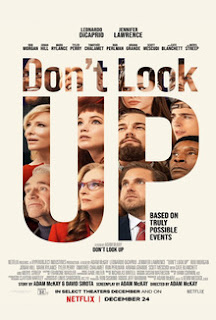
Don't Look Up (The Movie)


Its production having been delayed by the pandemic, Don't Look Up is a newly released satirical sci-fi film, advertised as an allegory about climate change and about government and popular culture's inattention to this problem and generally endemic lack of seriousness. It stars Leonardo DiCapiro and Jennifer Lawrence as two midwestern astronomers who discover a new comet and who then try to warn a Trump-like President (Meryl Streep) and the rest of the country about the comet, which is on course to hit the earth in six months' time and possibly extinguish human life (or at least human civilization) when it does so. As of last week, Don't Look Up was the third most watched Netflix film ever, which may say something about the film's appeal but perhaps also about its topicality - not only as an allegory about the climate crisis but also about our more immediate experience of the global pandemic and cynicism about governments' inadequate responses and the wider failure of much of our ambient popular and elite cultures in confronting this crisis - and presumably any crisis of comparable seriousness.

As satire it certainly works, if somewhat formulaic and unsurprising in its extreme cynicism about everything from the sheer silliness and mind-numbing stupidity of daytime TV to capitalist greed and the corrupt character of the rest of our elite culture, including legacy prestige institutions and science aligned with government, and finally to how the zone gets flooded (to adapt a Steve Bannon phrase) with misinformation and disinformation and even (in this case) comet denialism. In an especially apt nod to our present predicament, it even illustrates the pattern of elitist contempt that underlies the manipulation of populist rhetoric.

It also offers some serious stuff about what matters most in life, and about how different people deal with disaster and die as they lived.

A troubling but entertainingly suggestive film for this terrible time in which we now find ourselves!


Sunday, January 9, 2022

Heaven Has Opened


Traditionally, churches have been built facing east, and the standard location for the baptismal font has been the northwest corner. For various reasons, this church was built facing a different direction; but internally the traditional alignment was followed for the font (designed by the great American artist  John LaFarge in 1891). So the baptismal font was originally located in what is actually the southeast corner (but which would be the northwest corner if the church faced east). In the 1980s, the font was moved, but the original site can still be immediately identified by Alvin Alfred Lee’s copy of Bellini’s painting The Baptism of Christ, portraying Jesus’ Baptism by John, the theme of today’s feast.

At Jesus’ baptism by John in the Jordan River, God the Father officially identified Jesus as his Son, and the Holy Spirit descended upon him. Analogously, at our baptism, through the gift of the same Holy Spirit, we in turn identify ourselves with the Son, and so share in our own way in his relationship with his Father. So Jesus’ baptism anticipates the baptism that has elevated us to a new status in relation to the Father and so empowered us to continue Christ’s life and mission in our world though his Church.

That said, the focus of today’s celebration is primarily on Jesus’ baptism, not ours - and actually mainly about what followed after Jesus had been baptized and was praying, when heaven was opened for a revelation of his status as the eternal Son of God. While God the Father’s words themselves seem to have been addressed directly to Jesus alone, the event itself has been recounted for our benefit. In this revelation, in this “epiphany,” we get a glimpse of the hitherto hidden, inner life of God, now suddenly revealed in what God is doing, for us, through Jesus’ mission as messiah.

Something really new and wonderful is happening here. Heaven has opened. The barrier between heaven and earth, between God and us, has been breached, and the (until now) invisible God has not only spoken, but has become visible for us as his Son, who has revealed God to us in a way we would never otherwise have known - in what Saint Paul, writing to Titus, called the kindness and generous love of God our savior. We are invited to accept God’s kindness and generous love ourselves, as his own people, prepared to be transformed, as Saint Paul put it - eager to do what is good.

It is no accident that we heard the very same words of Saint Paul on Christmas itself. Although the cycle of Christmas-related festivals doesn’t completely conclude until we celebrate the Presentation of the Lord on February 2, today celebrates the fulfillment of the Christmas season. Measured by the secular time by which we rule our lives, today may seem like some sort of post-holiday afterthought. Actually, however, the identification of Jesus as the Son of God and the revelation of the kindness and generous love of God our savior in Jesus’ public mission are what the whole Advent-Christmas season has been leading up to.

Those wiser than I about such things say that Isaiah’s words, typically translated as speak tenderly to Jerusalem, may more literally mean “to speak to the heart” – as in, “to convince.” The human heart was understood by Isaiah’s contemporaries as the organ of thought and reasoning, God is here being spoken of as trying to convince Israel of the reality of his concern.

It wasn’t just ancient Israel that had a hard time and so needed convincing, of course.  Even the most cursory look at the state of the world – one year after the insurrection and entering the third year of this covid pandemic -belies any credible “happy days are here again” fantasies. If something new and wonderful really is happening here, it is going to take some convincing. It requires nothing less than the kindness and generous love of God our savior appearing personally in God’s Son.

In my opinion, the biggest stumbling block to faith is not so much science or evolution or any of those sorts of things (important though those issues may genuinely be), but rather the all-too vivid contrast between what we actually experience and what we profess to believe - between the seemingly endless cycle of human suffering so many actually experience and this seemingly contrary-to-fact belief in a future full of hope, and, more personally perhaps, between my ordinary somewhat self-absorbed life and being part of a people eager to do what is good, the belief that something new and wonderful really can happen and is happening, that the kindness and generous love of God our savior really have appeared. The fact is that we would never have had any reason to believe in such a thing, to hope for such a thing, even to suspect such a thing, if God himself had not told us, if God’s Son had not actually shown us - by becoming one of us. And that is what the Christmas season celebrates so seriously. We would never have experienced this, had it not been for the mission which the Son of God began on our behalf at his baptism, the same mission he challenges us to continue in our world today through his holy Church.

Homily for the feast of the Baptism of the Lord, Saint Paul the Apostle Church, New York, January 9, 2022. (The scripture references are to the proper readings for this feast in Year "C" - Isaiah 40:1-5. 9-11; Titus 2:11-14; 3:4-7; Luke 3:15-16, 21-22.)

Photo: Baptism of Christ (c. 1500-1502), a painting by Giovanni Bellini (1430-1516) in the Chiesa di Santa Corona, Vicenza, Italy.