Wednesday, August 9, 2023

The Greatest of Centuries?


The Greatest of Centuries? Certainly not the 20th, perhaps the bloodiest in human history! Nor the 21st, which so far seems steeped if not in blood then certainly in carnage created by technology and fostered by seemingly unbridgeable human divisions!

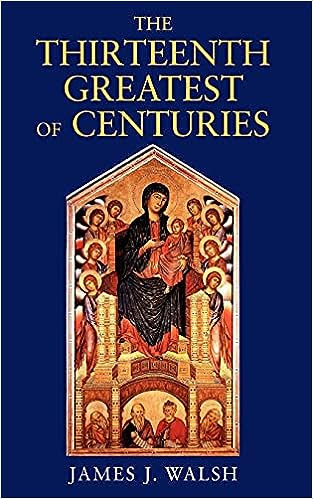
In the era and subculture in which I was first formed, however, there would have been no doubt which century was greatest. In my mid-century childhood, in the narrow provincial world of American Catholic culture, the influence of a certain medieval ideal (fed by 19th-century romanticism and by Pope Leo XIII's neo-scholastic revival) was immense. Hence, James J. Walsh's then popular book, The Thirteenth Greatest of Centuries (NY: Catholic Summer School Press, 1907), which this long hot summer has inspired me to recall, revisiting the popular 20th-century Catholic cultural and political project of a revived Christendom. As Church historian Joseph A. Komonchak once wrote: "For a model of its political and cultural project, the Church turned to its own history and found it, not in the state religion of the ancien régime, nor in the Counter-Reformation, but in an idealized Middle Ages" ["Modernity and the Construction of Roman Catholicism," Cristianesimo nella storia, 18 (1997): 353-385, p. 361].

In addition to all the obvious things to applaud about the Christendom of the High Middle Ages (e.g., Saint Thomas Aquinas, Saint Louis IX, the greatest Latin hymns, the universities), Walsh  - perhaps unsurprisingly given the era in which he was writing - also reflects a certain "whiggish" view of history, which celebrates the development of liberal democratic institutions, organically traceable in important respects to high medieval developments. Whatever the merits and demerits of whiggish historiography, it is not integralism. The post-Enlightenment romantic medievalism that might have inspired one to want to read a book called The Thirteenth Greatest of Centuries certainly served as an antidote to Enlightenment liberalism, but in actual practice probably aspired more to a purification of the present than a return to the past.

Of course, whig history has its own problems, which is its own discussion. So does uncritical romantic medievalism. Putting aside the obvious fact that most (if not all) of us would infinitely prefer to live in a world with electricity and indoor plumbing, not to mention antibiotics and vaccines, no matter how much one looks longingly back at Christendom, there is no going back. One need not embrace either a whiggish philosophy of liberal historical progress or a Marxist materialist dialectic to recognize that historical change is largely irreversible.

If at times a somewhat superficial reading of Servant of God Isaac Hecker (1819-1888) might suggest an excessively celebratory appreciation of 19th-century American democracy and a somewhat too easy reconciliation of Catholicism and modernity, nonetheless his overall interpretation of what was happening in the world and its challenge for the Church represented (while committed to remaining faithful to the Church's true calling) a real alternative both to a reactionary integralism that would have wished to return to pre-revolutionary absolutism and to a romantic medievalism that would have wished to recover an only partly historical, idealized, gemeinshaftlich Christendom, to which it is inevitably impossible to return.

The key, of. course, is remaining faithful to the Church's true calling, which must inevitably transcend any century, however great. The more alienated from modernity one feels oneself to be, the more extreme will be one's condemnation of the actual present and the more extreme the search for an alternative Christendom, usually identified with some increasingly idealized past. On the other hand, the more willing one is to identify some authentic values in the present, the more able and likely one will be to enable a bridge between that Christian calling and participation in modernity, thereby becoming, what Charles Taylor has memorably called "modern civilization's 'loyal opposition'."


Monday, August 7, 2023

Saint Augustine and the Women Who Formed Him


Browsing in Barnes and Noble recently, I came across a strangely titled book, Queens of a Fallen World: The Lost Women of Augustine's Confessions (Basic Books, 2023), by Kate Cooper, Professor of History at Royal Holloway, University of London. So strange did that title seem that I might easily have passed it by, had I not noticed the blurb on the back cover by esteemed historian and Augustine scholar Peter Brown, who labeled it a "masterpiece of the historian's art" and "a rare balance of state-of-the-art erudition and felicitous hypotheses." That was hard to resist. Thanks to Brown, I bought the book. Once opened, it was hard to close.

That said, its title is still somewhat strange. It is really a book about Augustine and the important part played by two women in particular - his mother Monica (obviously) and the unnamed woman who was the mother of his son Adeodatus, whom Cooper calls Una. Ostensibly the book aims to highlight four women - the Empress Justina and Augustine's unnamed betrothed, whom Cooper calls Tacita, in addition to Monica and Una. In fact, however, Empress Justina and 10-yer old Tacita, are themselves personally much less significant than either Monica or Una. 

The book's biographical accounts of the Empress Justina and Saint Monica is interesting, as are the author's much more speculative treatments of the less well documented lives and circumstances of the two unnamed women in Augustine's story. In my judgment, however, the book's major contributions are its detailed analysis of Roman marriage laws and customs, its speculations concerning their eventual effect on Augustine and his "conversion," and his consequent commitment as a Catholic Bishop to a new theology of marriage.

In our current ritualization of Christian marriage, we still practice the Roman dextrarum iunctio (the joining of the right hands) and we still require the consent of the parties; but, in other important respects, Roman marriage (even among 4th-century Christians) was quite different from how we understand Christian marriage today. Marriage between free Roman citizens "cemented a reproductive collaboration between two separate families, establishing a secure answer to questions about property - that is, which among a man's biological offspring could claim rights as his heirs." Concubinage, in contrast, which normally involved a relationship with someone of lower status (a slave or a freedwoman), was not about producing heirs. In fact, "it was seen as entirely honorable for a man to have children whom he did not intend to support."

As anyone familiar with Augustine's story knows, Augustine's parents had not arranged a suitable marriage for their son when he was young, presumably in expectation that a better marriage might be arranged later with a family with wealth and connections which would advance Augustine's career. That was all a perfectly normal and respectable aspiration in that culture.  In the meantime, the young Augustine took a concubine, with whom he eventually had a son, Adeodatus. This was also a perfectly normal and respectable thing to do in that society. Later, when they were all settled in Milan, Monica sought the sort of marriage which would be financially advantageous for Augustine, and an engagement with a 10-year old heiress was appropriately arranged. Thanks to what Cooper calls "the unquestioned cruelty of the Roman approach to family life," Augustine was inevitably expected to end his relationship with the mother of his son. He did so, and she duly returned to Africa. But neither Monica nor her ambitious, upwardly mobile son "seems to have grasped what it would cost him to put the plan into action." Cooper argues that Augustine "had failed to anticipate the agony caused by severing the deep emotional bonds of a long life together - a life that he, at least, had found unusually happy."

Here Cooper gets somewhat speculative. She highlights how "really it was money, not sexual renunciation, that loomed large at the center of the debate" between Augustine and Alypius at that point in the Confessions. In her very plausible reading of Augustine's Confessions, "the received view is not wrong that Augustine was recoiling from sin when he decided not to marry. But the sin that repulsed him was not lust; it was greed." She argues that breaking his engagement "was not a rejection of sex but a revelation about money and loyalty - a refusal to sell himself, a desire to live up to the implicit if unspoken promise that he now saw he had made to Una."

For those whom Cooper calls "civic-minded bishops," like the celibate Augustine and his happily married friend Paulinus, Bishop of Nola, "the outsized craving that was most spiritually dangerous was not lust but the love of money."

As a bishop, Augustine famously "would argue that a man who had lived with a concubine should not be allowed to marry," that (contrary to Roman law and custom) "the church should see the union as spiritually equivalent to marriage," and "that in moral terms an established extramarital relationship carried the same responsibility as the legal bond of marriage." Influenced by his own intensely lived experience, Augustine as a bishop moved the Church's thinking about marriage away from its classical Roman expression and into a radically new and more egalitarian direction.

Augustine's reframing of the Church's appreciation of marriage is well known. What is so interesting and illuminating in Cooper's approach is the emphasis she places on Augustine's personal relationship with the woman Cooper calls Una. That Augustine condemned greed as a sin is hardly a new discovery. But the connection Cooper highlights between greed and the institutional arrangements surrounding Roman marriage and concubinage represents a genuine insight of perennial importance.

The legal and social structures of marriage have changed since Augustine's time, but the phenomenon of men dumping a long-time partner for a younger "trophy wife" or an otherwise advantageous new match remains still very real in today's late capitalist world, where we are again being pressed to recognize the insidious power of greed and its corrupting effect upon all social institutions.  This recognition ought to incentivize us to reprioritize the sins which undermine our moral capacities, our social commitments, and (a new issue) our care for our common home, as Pope Francis calls our environmentally challenged planet.

Saturday, August 5, 2023

An Ancient Miracle for a Heating-Up World


More than half a century ago, for a few months in 1967, I occasionally attended Mass at Our Lady of the Snows Church in Glen Oaks, Queens. It would be yet another 20+ years before I would get to visit the original Our Lady of the Snows, the Papal Basilica of Santa Maria Maggiore in Rome, the anniversary of whose dedication the Church celebrates today. Annually on this day, a shower of white rose petals drops from the ceiling of that Basilica to commemorate the legendary miraculous snowfall that appeared overnight on this date sometime in the mid-4th-century on Rome's Esquiline Hill, at the height of the hot Roman summer, to signify where Our Lady wished the Basilica to be built. In the Middle Ages (prior to the Tridentine Reform), there was even a special collect for this feast, which referenced the snowfall in the heat of summer and petitioned for a corresponding cooling of desire.

Rome, Europe, and the United States are all a lot hotter now than they were then, thanks to the climate change so many of ur politicians still find it politically advantageous to deny.  How much more does the world need an even bigger miracle of the snow today! How much more do we need to cool not only the external temperature of out world but our increasing consumerist desires which have fed it!

Whatever happened on that hot 4th-century August night in Rome, we have a fairly clear idea of what is happened now in and to our heating-up world - the more temperate, life-friendly world which we are rapidly destroying and the hotter, less life-friendly world we are in the process of replacing it with.

PhotoPainting by Masolino da Panicale (1383-1447) depicting the miraculous snowfall and Pope Liberius (352–366) tracing in the snow the ground plan for the future basilica, with Jesus and Mary in a circular halo supervising the event (Museo Nazionale di Capodimonte, Naples).

Thursday, August 3, 2023

Losing Our Religion


More than once in these pages, I have quoted Russell Moore's famous observation that the religious right has turned out to be the people the religious right warned us aboutMoore previously served as the president of the Ethics and Religious Liberty Commission, the policy wing of the Southern Baptist Convention, and has since become the most prominent evangelical voice in opposition to Donald Trump. Currently, Moore is editor in chief of Christianity Today. Now, in his latest book, Losing Our Religion: An Altar Call for Evangelical America (Penguin, 2023), there is an analogous memorable phrase, referring to young people "walking away from evangelicalism not because they do not believe what the church teaches, but because they believe the church itself does not believe what the church teaches."  The problem Moore identifies "is not that people think the church’s way of life is too demanding, too morally rigorous, but that they have come to think the church doesn’t believe its own moral teachings."

Losing Our Religion: An Altar Call for Evangelical America is largely a personal reflection on this experience (Moore having been until recently an insider in Southern Baptist circles), and a sort of spiritual diagnosis of the problem, a problem which, I suspect, applies to a greater or lesser degree to much of American Christianity. Much of that phenomenon has obviously been associated with the political effect of the evangelical alliance with Donald Trump, and Trump does indeed figure in this book, as he has in Moore's public posture since Trump's appearance on the political scene. But Trump is more the symptom than the cause of the problem Moore seeks to analyze and diagnose.

"Losing my religion," the idiomatic southernism which gives the book its title, has to do with losing one's patience, "when politeness gives way to anger."

In Moore's analysis, "confidence in the kingdom of Christ" ought to enable us "to stop looking for substitutes for him."  But, in their panic "about rising secularism and what they fear will be hostility to the church," some "act in ways that tie the witness of the church to forms of power that actually fuel secularization."

In Moore's case, he has increasingly recognized "a dread deep within me that Christianity might just be southern culture of politics, with Jesus affixed as a hood ornament."Whether the concern is "political idolatry or populist demagoguery or white nationalism or toxic masculinity" or whatever, the fact is "that as awful as all of those horrors are, they are made worse when they are framed as badges of religious identity."

The wider context for all this is the rapid decline in American religious affiliation - from some 68% of American affiliated with a church or other religious body some 20 years ago to just 47% now. Moore seems to agree with those studies that suggest "that the politicization of American religion is a key driver of people away from religious affiliation." He cites political scientist Daniel K. Williams, who calls, “Iapsed evangelical Protestants" the largest religious body in the South.” Williams has shown that these de-churched “evangelicals” are  "liberalizing, to be sure, but only on the specific sins they want to commit." Having left the Church, "they retain the moralism—at least insofar as it pertains to other people—but lose the sense of self-sacrifice and trust in others,” They also "lose whatever willingness they had to care for other people in community.” This is part of a larger phenomenon, in which almost any disconnection "from organic community leads to extremism and anger—no matter the place on the ideological spectrum." (He illustrates this on the Left by recalling how leadership of leftist movements by labor unions and of civil right movements by pastors has given way to "de-churched Protestants," who "are far more hyper-individualistic, cynical, and distrustful of others," and are  "also much more likely to be lonely, disconnected, suspicious of institutions, and angry."

One of the dimensions of the crisis which Moore diagnoses is that "it is not just that we are divided about what we value about the way things should be, but what we are allowed to say about the way things actually are. Now, notice, what I wrote here is not what we see about the way things are, but what we are allowed to say. This is because we live in a time in which 'truth' is seen as a means to tribal belonging, rather than as a reality that exists outside of us. And that’s true even among, sometimes even especially among, those who spent the last twenty years arguing about the dangers of postmodern relativistic ideas of 'truth' and the rejection of metanarratives'.” Against all that, Moore reminds us "that bearing false witness is a sin, and that lying distorts not just the truth but us."

Prescriptively, Moore makes recommendations aimed at recovering American Christianity's evangelical heart. He reminds his readers that, while they're a multiple experiences of legitimate authority, some revealed as embedded in creation, "Scripture is the final authority, the norm that norms all other norms." This, of course, contrasts, with the contemporary phenomenon which political scientist Christopher Freiman calls the “monopolization of our identity by politics.” Moore also cites the research of Tobias Cremer in the use of Christianity in populist movements, in which otherwise unchurched people display Christian symbols, all of which represents “extreme form of a secularized Christianity” in which such concepts can serve as symbols of an imagined “white and masculine past.” (Here Moore specifically references "the Jesus Saves sign and other Christian symbols at the January 6, 2021, attack on the Capitol.")

Moore characterizes such phenomena as "not a politically enthusiastic version of Christianity, nor is it a religiously informed patriotism. Christian nationalism is a prosperity gospel for nation-states, a liberation theology for white people. ... Christian nationalism cannot turn back secularism, because it is just another form of it."

One wholesome counter to all that lie sins he recognition that authentic Christianity is always global in its orientation. "White American Christians" Moore notes are neither a “moral majority” nor a “silent majority” nor "any majority at all, unless we define our primary culture as that of the United States of America. If, instead, our first identity is part of the global Body of Christ, then white middle-class Americans are a tiny sliver indeed, and the driving force of Christian orthodoxy and spiritual energy in the world, and even in the United States, is not white and middle-class. And where there is evangelistic energy within American evangelicalism, such is often centered in immigrant churches, whether Dominican or Cambodian or Nigerian or Iranian." Much the same could be said of other Protestant denominations and of the Catholic Church.

In recent years, Moore has become perhaps the primary internal (i.e., within Christianity) critic of the tragic trajectory of much of  American Christianity. This book is another valuable contribution to that much needed critique. His work serves as a wholesome reminder of the true means of evangelical. To evangelize, as Pope Saint Paul VI reminded Catholic Christians in 1975, is the essential mission of the Church. When Christians are evangelical in the true sense, they see their fellow countrymen as neighbors with whom the good news is to be shared. The choice to recognize America as a locus for mission is a religious choice. The choice to recognize America as a locus for culture war - and our neighbors as enemies in that war - is a political choice.


Tuesday, August 1, 2023

Spirituality for Our Time and Place


Servant of God Isaac Thomas Hecker (1819-1888), the founder of the Paulist Fathers, who was received into the Catholic Church on this date in 1844, was no Saint Augustine, of whom Saint Isidore of Seville is supposed to have said that anyone who claims to have read all of Augustine's wirings is a liar. That said, Hecker is certainly up there in the pantheon of religious authors who have written much, and about whom accordingly also much has in turn been written! Recently, I encountered another book-length study of Hecker, of which I had been hitherto unaware: The Spirituality of Isaac Thomas Hecker: Reconciling the American Character and the Catholic Faith, by Martin J. Kirk, CMF (NY: Garland, 1988).

In my Ascension Thursday homily, last May 18, at the Mass for the opening of the Paulist Fathers' Hecker Symposium: Servant of God Isaac Hecker and the Church of Our Age, I highlighted Hecker's love for the Church as the continuation and expansion of the body of Christ in time and space.  So I was very happy to find this volume in which the author places so much emphasis on Hecker's devotion to the person of Christ and the centrality of the mystery of the Incarnation. For Hecker, according to Kirk, "the central event of the Christian experience was the incarnation, understood as a new creation, restoring to its original destiny the first creation" (p. 144). Already by the time of. his conversion, Hecker had become convinced that "the Church was the source of Christ's life in the world today" (p. 169), the she "is the body of Christ living in the present world" (p. 170; cf. also Hecker's Diary entries for November 15 1843, and May 10, 1844). 

In terms of Influences on Hecker in this direction, Kirk identifies Orestes Brownson, Möhler's Symbolik, and the Oxford Tracts. For Möhler, the rationale for the visibility of the Church was to be found in the Incarnation. I have been less attentive in the past to the influence of the Tracts on Hecker, but Kirk highlights Hecker's frequent references to them in his 1843-1844 letters. And "the belief in the Church as the living body of Christ was common to all the Tractarians" (p. 173).

Kirk's subtitle is Reconciling the American Character and the Catholic Faith, but in treating that commonly emphasized aspect of Hecker's thought the book dives deeply into such central issues as the significance of Hecker's own experience - social and political as well as religious - for his thinking, Hecker's personal appreciation of the relationship between "active" and "passive" virtues (an issue which would prove important in the context of subsequent controversy after Hecker's death), and his emphasis on the experiential nature of spirituality. Kirk stresses how Hecker "found reconciliation where others found opposition," emphasizing "the harmonious relationship between nature and grace, between God's kingdom and the world,  between faith and reason, between the interior life and man's responsibility for the social order, between doctrine and experience." And "the key to his view of all these realities was the reconciliation between God and man that he saw symbolized in the Incarnation" (p. 372).

Along the way, Kirk offers some interesting insights into the important part played by Saint Francis de Sales on Hecker - as early as 1844 and as late as 1873 when he visited and said Mass at Saint Francis de Sales' tomb. Kirk also adds to our appreciation of Hecker's spiritual debt to the great Jesuit authors Lallemant and de Causade and to Lallemant's disciples Rigoleuc and Surin. He also discusses the influences of three non-Jesuit authors, Saint Catherine of Genoa, Saint Teresa of Avila, and Saint John of the Cross. Kirk's treatment of Hecker's approach to spiritual direction is especially rewarding to read. (One interesting aside is the fact that a spiritual director Hecker recommended to Brownson in 1851 was his fellow Redemptorist, later Bishop of Philadelphia, now Saint John Neumann.)

Personally, I think Kirk might have been a bit more critical of Hecker's very 19th-century way of talking about national character. Kirk does, however, propose some very useful critique in his conclusion that "Hecker's thought can be criticized on both the internal merit of his argument, at least in regard to the harmony between Catholic anthropology and American democracy and on the attitude or stance he takes which is not only open to the American culture but almost entirely non-critical in its acceptance of the American way of life" (p. 379). 

Regarding the first, Kirk notes the familiar argument that the American political system was founded on a more pessimistic view of human nature and a certain suspicion of political power. Regarding the second point, Kirk worries whether there may be "no room in Hecker's thought regarding the relationship of Catholicism to America for a prophetic stance, or for a stance which disengages itself from culture ignorer to critically evaluate it in light of the Gospel" (p. 381). The latter issue he sees as part of a larger historic problematic that the Church in the U.S. "has not been, in general, and effective source of healthy criticism of American society" (p. 382). These are useful critiques, an important contribution to the task of retrieving Hecker 19th-century spirituality in a very different 21st-century America.