Sunday, May 1, 2022

May Day


One of the ironies of modern history is that May Day, for centuries a major seasonal turning point (the first day of summer) in an agriculturally oriented, nature-based calendar, became in the 19th century a day dedicated - of all post-agricultural, post nature-based things - to modern industrial labor and the proletariat it produced. Before it became an International Workers' Holiday, May Day was more about dancing around the maypole and crowning the May Queen (a remote antecedent of the contemporary Catholic May Procession and Crowning). Undoubtedly, some contemporary "neopagans" may be reconstructing some of those older nature-cycle pagan festivals and again celebrating May Day as a pagan religious festival

May Day still survives as a workers' holiday, of course, but barely (following the collapse of communism and the eclipse of socialism). In the United States, where we have a different "Labor Day" holiday and May Day has accordingly always resonated less among the "working classes" than in Europe, it is the labor movement itself which has been eclipsed. In the 20th century, as Michael Kazin has shown in What it Took To Win: A History of the Democratic Party (Farrar, /Strauss, and Giroux, 2022), the U.S. Democratic Party became briefly, but very successfully, an American Labor Party. But those days appear long gone, and the U.S. Democratic Party has long since abandoned its identification with the "working classes" (to the party's own electoral detriment, as well as the detriment of the "working classes").

The political abandonment of the "working classes" has come about much more slowly in Europe. Moreover, the mid-20th-century post-war period in Europe was characterized by authentic religious outreach as well. This was reflected, for example, in the Mission de France and the "worker-priests" movement and, somewhat more superficially, in the mid-1950s invention of the Roman Catholic liturgical feast (photo) of S. Joseph Opifex, assigned by Pope Pius XII to this date, somewhat ironically referred to in the feast's original office as "a day which the workers have adopted as their own." While the new festival famously failed to outperform the more popular leftist May Day, in the process the new observance did displace another relatively modern feast in the Catholic calendar, that of the Patronage of Saint Joseph, celebrated in the 19th century on the Third Sunday after Easter and then in the 20th century on the Third Wednesday after Easter. Pius XII's ineffective innovation still survives - somewhat vestigially and not much noticed - in the Church's contemporary calendar.

In 2005, the newly elected Pope Benedict XVI (whose own given name, of course, was Joseph) made the best of what the calendar offered, somewhat unconvincingly calling this observance in honor of Saint Joseph the Worker "a liturgical Memorial very dear to the Christian people." Recalling how it had been established "to highlight the importance of work and of the presence of Christ and his Church in the working world," he expressed his "hope that work will be available, especially for young people, and that working conditions may be ever more respectful of the dignity of the human person." 

Two and a half centuries ago, Adam Smith (The Theory of Moral Sentiments, 1759), spoke disapprovingly about what he called “This disposition to admire, and almost to worship, the rich and the powerful, and to despise, or, at least, to neglect persons of poor and mean condition,” which he called “the great and most universal cause of the corruption of our moral sentiments.” How ironic that it is precisely such ordinary, unappreciated “persons of poor and mean condition,” whose social and economic well-being our society has largely neglected for decades, are now seen as “essential workers” - poorer people in low-paying jobs that our wealth-worshipping society habitually disrespects and whom this present pandemic so directly endangers.

We celebrate (or don't celebrate) "Saint Joseph the Worker" in the context of our current covid crisis, which has highlighted society’s collective dependence for survival on ordinary workers. These are workers ordinarily treated as unimportant compared with rich and powerful people whose work benefits largely only themselves and people like them - and certainly not society at large.

Friday, April 29, 2022

An Imaginative Adventure in Constitution-Making


Back in the 1970s, there was some talk (in the end, only talk) about invoking Article V to convoke a new constitutional convention. I was mildly supportive of the idea, mainly because I envisioned it as a rare opportunity to revive the participatory citizenship that had been eclipsed by the late 20th-century model of Americans as consumers rather than citizens. in fact, a new constitutional convention had no realistic chance of happening then. Nor does it now, although now (unlike then) there is increasing awareness of "how the document has helped foster a hopelessly broken government."

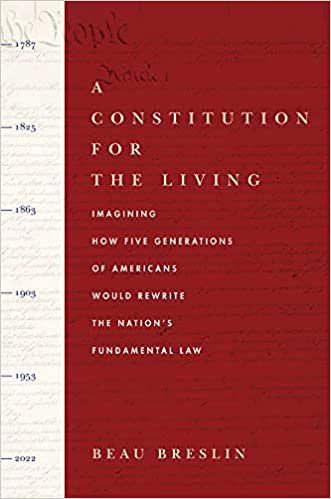
The author of that diagnosis, Political Scientist Beau Breslin, has recently responded to this discouraging reality with an imaginative exercise, A Constitution for the Living: Imagining How Five Generations of Americans Would Rewrite the Nation's Fundamental Law (Stanford U. Pr., 2021). The basis for Breslin's exercise is Thomas Jefferson's idiosyncratic (to my mind, completely crazy) that each generation should be free to start the constitutional process over again. One doesn't have to be a full-bore Burkean to sense the absurdity of Jefferson's position. Even so, one can also appreciate its appeal. In any case, Breslin takes Jefferson's idea and imagines what would have happened had the U.S. constitution been renegotiated and rewritten by each "generation." For Jefferson, that would have been every 19 years. Recognizing the increasing length of modern lifespans, Breslin opts for imagining new constitutional conventions in 1825, 1863, 1903, 1953, and 2022.

Obviously this is an exercise in counter-factual history. However, Breslin works hard to imagine how each constitutional rewrite might have worked out, based on what was actually happening in American society at the time - including, for example, what was being written in new or revised state constitutions in each period. so, while obviously an exercise in imaginative fantasy, Breslin's imagined constitutional renegotiations do open a window into the complexities of our constitution's adaptiveness to the dramatic changes in society.

Personally, while I have no use for Jefferson's anti-historic theory of generational independence, I do believe that times and circumstances do change and that with those changed times and circumstances comes a need for social and political change, including institutional adaptation. Breslin's book both recognizes this and show us how it might have happened (and could yet happen through our more cumbersome amendment process).

In Breslin's account, the first such imagined "convention" occurred in 1825, one year after the contested 1824 election, in which the House of Representatives elected John Quincy Adams over Andrew Jackson (who had gotten the most votes in the original election). Unsurprisingly, the convention reexamined the Electoral College. And, in a major victory for the Jacksonian Democrats, the 1825 Constitution provided for the popular election of presidential electors. In a similar vein the new document guaranteed universal white male suffrage. (Both were in fact the actual direction in which most states were tending at the time.) Bringing the federal constitution into greater harmony with most state constitutions, the imagined 1825 document relocated the Bill of Rights as the first article of the federal constitution, thus highlighting its priority. But an attempt to include a right to education was voted down. Even staunch Jacksonians "could not see their way to supporting the interests of the free common man if that meant states had to relinquish control over their own educational systems." Breslin's imagined convention's most significant change to its 1787 predecessor was one which was not reflected in American historical reality, a change in the manner of staffing the federal judiciary.

The 1863 convention occurred, of course, during the Civil War. As part of the dramatic fiction, Breslin has it relocated from Philadelphia to Boston to avoid danger from Lee's Confederate army. Not surprisingly, given the absence of representatives from the southern states and the  dominance of the radical wing of the Republican party, what this convention produced closely resembles the actual federal constitution as radically amended after the Civil War by the 13th, 14th, and 15th amendments. In fact, the three Reconstruction Amendments did actually give the U.S. a radically revised constitution, but (we all know the sad story) the federal government failed to enforce that new constitution - with calamitous consequences we are still dealign with today.

The next 50 years were defined by the rise of commercial capitalism and urban immigration, thus definitely putting behind the Jeffersonian-Jacksonian vision. As Breslin notes, "the framers of the 1863 Constitution likely would not even have recognized their own country in 1903." In actual history, of course, Theodore Roosevelt was president, and it was the Progressive Era. So unsurprisingly, women's suffrage passed at Breslin's 1903 convention, but proposals to recover for Native-Americans a degree of self-rule over Indian lands was defeated. finally, reflecting the then reigning imperial turn in American foreign policy, the convention enhanced presidential power in that are, allowing the president to "pursue strategic national interests abroad" and  to "execute all necessary and proper policies  to protect the country;'s vital global interests."

So again the imaginary 1903 convention largely condenses what actually happened. (In fact, the constitution has never really been amended to reflect either American Empire or the imperial presidency that necessarily accompanies it, but Breslin's device does reflect the de facto acceptance of almost unlimited presidential power in this area.) 

Imagined constitutional changes cannot stray too far from what actually has happened for obvious reasons. "Efforts to raze the prior Constitution altogether and take a fresh look at what a twentieth-century generation might might desire failed" at Breslin's imagined 1903 convention, "because of expediency and because of a belief that the basic architecture of the American political system still functioned reasonably well."

The 1953 iteration of this fantasy project produced a longer constitution, "and the evidence of interest group activity was obvious." Another background difference was that state constitution framing had diminished in the interim, although state constitutional amendments had "increased dramatically" in those 50 years.

Obviously, the 1953 convention reflected the enormous changes in federal and presidential power during the New Deal and two world wars. America "had been molded in FDR's image" and all "were now living in FDR's world." The 1953 convention limited presidents to two terms (in the exact language of the actual 22nd Amendment). Reflecting the increasing primacy of national identity, the convention called for unanimity among all 48 states as a requirement for ratification.

The convention's preoccupation with recent Supreme Court decisions highlights one practical problem with this thought experiment. The 1825 convention had altered the way the federal judiciary was filled. But, since that never actually happened, the court decisions that impacted American society between then and now are the same. 

All of which brings us at last to our problematic present - in the form of the constitutional convention of 2022. Breslin adapts his model to current technology and employs a cumbersome "crowdsourcing" preparation. (And, of course, C-Span covers the convention live.) But the most decisive factor was (i.e., is) "the deep divide - political and otherwise - facing the country."

Unsurprisingly, the 2022 convention is the first  since 1787 to reconsider "the basic architecture of American government." The imagined debate begins with the perennially popular, if controversial, question of term limits. The arguments on both sides are familiar and need not be repeated here. In the end, Breslin's convention limits House members to four terms and Senators to two, but (to my mind much more importantly) prohibits former lawmakers from becoming lobbyists for four years after leaving congress.

Climate change is perhaps the major issue facing the world today. Already, several state constitutions include some reference to the environment. Breslin's 2022 constitution includes a constitutional right (albeit perhaps primarily hortatory) to a clean and healthy environment.  As we all know, the problem with protecting the environment and fighting climate change is not acknowledging its desirability but taking actions that actually require a change in our current, wasteful way of life.

At this point Breslin become effectively an advocate for Sanford Levinson's constitutional reform agenda, addressing "the illegitimacy of the Senate, the inability of the people to vote that they had 'no confidence' in their President, and the absurdly difficult method for amending or reforming the constitutional document." Of course, Breslin's jeffersonian fantasy of regular constitutional conventions were a reality, Levinson's legitimate concern about the inordinate difficulty of amending the constitution would be mulch less salient!

Levinson's proposal for a parliamentary-style congressional vote of "no confidence" reflects the abysmal history of presidential impeachment and its effective irrelevance as a constitutional tool. Breslin's convention adopts "no confidence," but not Levinson's more radical suggestion of  a national recall. (Hasn't California sufficiently taught us the harm recalls can do?) Most importantly, however, at the 2022 convention, the Electoral College is finally abolished, which alone might make such an exercise a valuable one!

Thanks to the crowdsourcing technique (and reflecting our presently polarized politics) controversial cultural questions are also debated at this final convention. Neither side being willing to concede any ground on abortion and a constitutional right to privacy, the convention reflects contemporary reality by tabling the topic and never returning to it. On the other hand, obviously reflecting the apparent trajectory of public opinion (at least until recently), "marriage equality" is more successful in getting enshrined in the constitution. (This book was obviously written before the contemporary Republican party's renewed anti-gay panic.)

Gun rights, like abortion, are an area where the division between Americans is too wide and too deep, and even at a fictional convention no change is possible.

Finally, in an effort to come to terms with America's problematic past, the venerable Preamble (which my generation faithfully memorized in school) is lengthened to list all sorts of now lamented past evils.

Breslin does a very good job getting the reader to play along and imagine these various conventions. It is a salutary reminder that a more participatory process and altered institutions should not be beyond the pale of our imagination. At the same time, it illustrates how, while constitutional arrangements may complicate our political problems and make them worse) they do largely reflect our problems and divisions, thereby limiting the realistic extent of what alternatives may realistically be imagined.


Thursday, April 28, 2022

20th-Century "Soldiers of God" (The Book)


When I was in high school in the early 1960s, I came across a book about the French Worker-Priests Movement, which was by then already past history. It didn't make me want to become a worker-priest, but it did make me mildly interested in the new and lively developments in post-war French Catholicism. I then came across that post-war renaissance of French Catholicism indirectly in college when I first read and studied Albert Camus, who did engage intellectually with contemporary Catholic thinkers in France, especially among the Dominicans. Then in grad school, I delved into Jacques Maritain's political philosophy and the larger trajectory of the evolution of his thought in relation to 20th-century French Catholic political thought. Finally, in seminary, I studied the impact of French nouvelle theologie at Vatican II. 

So it was with eager interest that I recently read Sarah Shortall's fascinating study of some of those impactful 20th-century French Jesuit and Dominican theologians, Soldiers of God in a Secular World: Catholic Theology and Twentieth-Century French Politics (Harvard U. Pr., 2021). I am sure that genuine scholars have already adequately reviewed Shortall's fine work. Without attempting anything like a thorough review, there are a few aspects about her study that I would particularly like to highlight.

There are any number of reasons why one should find the pioneering work of those 20th-century French Jesuit and Dominican theologians particularly interesting, not least because of the influence they exerted in the run up to (and during) the Second Vatican Council. Also, while the France in which Jesuits Henri de Lubac and Gaston Fessard and Dominicans Marie-Dominique Chenu and Yves Congar were formed was one where secularism had legally won, it was a France where Catholicism and ideologies still identified with Catholicism (like the problematic, right-wing Action française) were still fighting back. For Shortall, "the key quandary facing the Catholic Church in the twentieth century" became "how to maintain a public role for itself once the institutions of public life has been secularized.” (Analogously, this was one of Paulist founder Isaac Hecker's concerns in the 19th century, a question still unresolved in the U.S. today.) It is her contention that, through the work of these theologians, “the Church became modern by asking, not how Catholics came to ‘accept’ or ‘embrace’ typically modern principles, but how they contested and transformed what it meant to be modern.” (In a sense, that was what Hecker was trying to do in offering Roman Catholicism as an alternative to Protestant Liberalism.)

The new theological responses the book identifies followed two broad directions. There were the Dominicans, who followed Saint Thomas Aquinas and made "a distinction between the natural and supernatural ends of human life, which allowed it to grant a certain degree of autonomy to temporal affairs," and there were the Jesuits, led by de Lubac, who went back farther than Thomas to the Church Fathers and who "insisted that it was not possible to imagine an autonomous order of human affairs that was oriented to a purely natural end" and so "looked to the Church rather than the state as the primary framework for collective life." Revived Thomism "tied the antimodernist Church of the turn of the century that reinvented itself as the primary defender of human rights and democracy in the latter half of the twentieth century," while the Jesuits rejected liberal politics' premises "including the primacy of the individual, the sovereignty of the state, and the distinction between the private and public spheres." But both approaches transcended (and presumably if retrieved might still help us today to transcend) secular political categories and distinctions between "right" and "left." 

The Leonine renewal of Thomism, was one way out of the 19th-century impasse, an alternative to integralist intransigence. But it may also allow too much to secularism. In contrast (like Hecker) “de Lubac stressed the internal dynamism of human nature, in which the supernatural was already at work, infusing and raising up the natural order from within.”

The first part of the book is particularly interesting for the way it connects the origins of these developments with both the Jesuits' and the Dominicans' experiences of "exile." After the separation of Church and State, the two communities were expelled from France and forced to relocate their formation - the Jesuits to the British island of Jersey and the Dominicans to Belgium. For Shortall, this isolation "served as a powerful stimulus for intellectual production." Not for the first time in the Church's history, the restrictions imposed by state persecution helped renew and revitalize the Church internally. Then, at the opposite extreme, so to speak, from the isolation of exile, compulsory military service during World War I, besides toning down the conflict between Church and State, brought the young Jesuits and Dominicans into contact with a whole other class of Frenchmen. "They were astounded by the level of unbelief they observed among the men they encountered in the trenches" and realized "the need for new apologetic and evangelical tools to bridge" the great gulf between the Church and the French masses.

Shortall also pays attention to something that students of ideas may otherwise overlook: "the need to attend to the communities and institutions in which religious thought takes shape," in particular "the distinctive spirituality fo the order and the affective bonds forged in the course of religious life" and  particularly the crucial role of friendship in the development of ideas.

The second section of the book addresses the experience of World War II, German occupation, and the Vichy regime. For many Catholics, still alienated from the secularist Third Republic, "Petain was the providential man sent to lead the nation in its penance." Shortall characterizes the Petain regime as "a rather vague project of moral and physical regeneration," which accordingly appealed to a wide audience, while achieving "a degree of Church-state harmony not seen since the 1870s." In this challenging situation, "theology became  a key political tool in the context of war precisely because it seemed to be apolitical." For the Jesuits, this period marked the beginning of a shift in focus from incarnation to eschatology, "a reorientation that would shape their postwar theological work in crucial ways." Meanwhile, on the Thomist side, "the war witnessed the first flowering of a distinctly Catholic human rights theory," which simultaneously defended universal human dignity against Nazi totalitarianism, while distancing itself from the 18th-century liberal tradition of rights."

The book's third part highlights the critical twenty years from the end of the war to the end of the the Second Vatican Council. This was the era of postwar Catholic engagement with the Left, the period of the Mission de France and the "Worker Priests" experiment. The Thomist model facilitated "acknowledging the presence of grace in even the most secular and anticlerical milieus." Chenu famously said: "The task of the missionary is not to figure out how the Church, as it is now, will be the shape of the world; it is to discover how the world, as it is now, will be the material for the Church." This was also the peak period of a vibrant Catholic existentialism, which "served as a counterpoint to the main Catholic humanism of the day - the Thomist anthropology that underwrote Jacques Maritain's theory of human rights."

Then came the crisis, the attack on the ressourcement project's "intrusion of historical thinking into theology" and the crackdown on the Catholic Left that even Maritain barely escaped. Even so, Shortall highlights how the movement was actually gaining influence during this period as a new generation of European theologians arose (among them Joseph Ratzinger) who were influenced by the likes of de Lubac, Chenu, and Congar, while Catholic students from Africa, Asia, and Latin America "became engaged in the main currents of French Catholic thought."

With Vatican II, nouvelle theologie came into its own. Yet the debate over Gaudium et Spes highlighted the split between the Thomist incarnational approach, with its positive valuation of worldly affairs, and the Jesuits' more Augustinian and eschatological emphasis on the centrality of the supernatural. "Both groups grappled with the same problem: how to bridge the divide between the church and the modern world without reducing one to the other." The split would be reflected in the post-conciliar split between the journals Concilium and Communio.

A brief Epilogue traces the continuing influence of these theologians in the dramatically changes context of post-Conciliar Catholicism, in which pews and seminaries emptied in Europe while the Church;'s demographic center shifted south. Liberation theologians found "a model capable of overcoming the separation between the natural and supernatural orders and endowing the struggle for social justice with redemptive value." In Europe too the "theological turn" in continental philosophy reflected "the affinities between Catholic antimodernism and secular postmodernism - their shared suspicion of the modern cult of universal reason, the transcendental subject, and historical progress." Meanwhile, secularism itself has come to be better understood as "a positive ideology in its own right, by which the state seeks to manage religion and police the public forms it can assume." 

A century later, that "exile" experience still speaks in part because it remains so relevant!


Rev. Ronald Franco, CSP

Wednesday, April 20, 2022

The Great Unmasking


It has been said that the one and only lesson we seem to learn from history is that we don't learn from history. So here we go again, ripping off the masks that, along with vaccines and boosters, have been our main protection against the insidious covid virus that shows no sign of departing the scene it has dominated for two years now. (Wearing masks in public has also protected many of us from flu and colds as well.) I flew on a plane Tuesday, the first full day after the infamous Trump-appointed Florida judge's malevolent ruling striking down the CDC's mask mandate. (Why, after all, should the government institution appointed precisely to protect public health be able actually to protect public health?) On the plane, I was one of maybe 10% at most who were wearing masks on the plane. I celebrated Mass in a church today where (thankfully) most congregants were masked but by no means all - even there in a neighborhood with one of the highest infection rates in the nation! Not only do we never seem to learn any lessons from even our most recent history, we seem as a society to revel in that regrettable reality. 

In hac lacrimarum valle, masks are a common-sense response to a dangerously ubiquitous but somewhat manageable threat. Common sense! What we used to call "ordinary" means of protecting one's own and others' health and well being. Nothing ultra-burdensome or "extraordinary," just common sense combined with a modicum of public-spiritedness.

Call it individualism or libertarianism or whatever, there is something in American culture that crosses class and other social divisions and unites our society in a rejection of public spiritedness, in a perennially persistent pattern of self-induced self-destruction.


Sunday, April 17, 2022

This Is the Day


Morning has always been my favorite time of day. Although I am almost always awake early, most mornings I have no reason to rush, now that I am in what we euphemistically call Senior Ministry. Morning Mass in the Motherhouse chapel is at 8:15. So most mornings I have plenty of time to sit in silence and savor the early morning quiet.


Every morning is, in a sense, a new beginning, a chance to start over. In 1st-century Jerusalem, the Sabbath Day’s rest would have been followed in the morning on the 1st day of the week by the typical urban hustle and bustle as people returned to their daily work and regular routines. It would have been business as usual too, although much more silently so, for the dead, decaying in their graves, who (then as now) were expected to stay dead. But, when Mary of Magdala came early in the morning, while it was still dark, she saw that the stone, that was intended to be a permanent barrier between the living and the dead, had been removed from the tomb.


John’s Gospel mentions Mary only. Other Gospel writers tell us she was accompanied by other women as well.


Like the tragic images we have seen in recent weeks of mass burials in Ukraine, and like the many abridged, truncated burials during the pandemic, Jesus had been buried in haste. He had died in the afternoon prior to Passover, as the Passover lambs were being sacrificed in the Temple. Having replaced that sacrifice with the sacrifice of himself, he was buried – in a hurry because of the impending holiday. So, the women’s purpose in visiting the tomb was mourn Jesus properly.


Instead, they found something surprising and unexpected. instead of staying in the tomb (as the dead, then as now, were expected to do), Jesus lives again – and lives a totally transformed and gloriously new kind of life. So, this 1st day of the week, we awaken not to business as usual, but to something totally new – to the greatest thing that God has ever done, the most important event in all of history.


And yet, however hard it may be for us to imagine (in this age of omnipresent social media and the 24-hour news cycle), at the time hardly anyone even noticed. It is rather the resurrection’s long-term effects, which we notice, which we experience, and which bring us here today – as Jesus’ body that lived and died and still forever bears the marks of his passion emerges from the tomb to transform our world, starting right here and now with us.

Even so, as we just heard, the first few made aware of this momentous news left the empty tomb more confused than elated: For they did not yet understand the Scripture that he had to rise from the dead.


In a world which seems permanently stuck in a dark, pre-dawn position, the disciples needed to experience the kind of change that could only come from the Risen Lord’s living presence among them. And so do we, which is why we are here, where the Risen Lord brings us together as no one else can.


Since have no visual or verbal record the actual moment of Jesus’ resurrection, what we have are the resurrection’s effects – first of all, on the disciples, and then on the world, and finally on us.


The resurrection’s effects on the disciples are what we read and hear in the gospel stories of, first, an empty tomb and, then, of appearances by the risen Lord – and still later in the preaching of Saint Peter and others in the Acts of the Apostles and in the amazing response of those who heard their preaching, and finally in the testimony and letters of Saint Paul, who wasn’t there at all at Easter, but who eventually experienced the risen Lord himself and was forever changed as a result.


The resurrection’s effects on the world were soon evident in people’s responses to the apostles’ amazing story, in how the story has since spread, in the dynamism at the heart of the Church’s existence that has propelled it outward in 2000 years of world-transforming activity.

Finally, its effects are evident in us, transformed in mind and changed in heart, by the unique power of this utterly unexpected event, which has glorified (almost beyond recognition) the humanity Jesus shares with each of us, and which has brought us together in a way in which nothing else could have, empowering us not so much with new knowledge as with a new hope.  (If “knowledge is power,” hope is even more so. Just ask the Ukrainians!)


So, instead of the 1st day of the week condemning the world back to business as usual, this 1st day after the Sabbath is starting something new – not just a new week, but a new world, where death no longer has the final say. We are here, in this holy place today because there is now a new day, on which God has, so to speak, re-created the world in his Son, Jesus Christ, crucified, dead, and buried, but now risen from the dead. That new day is today – and every day from now on, until we too will appear with him in glory [Colossians 3:4].  And so we say: This is the day the Lord has made! Let us rejoice and be glad!


And that is what brings us back Sunday after Sunday, to hear what happened next and so experience the effects of the resurrection ourselves. On my way into the church this morning, I paused at the parish photograph from 11 years ago. I thought of all the people in that amazing photo, whom I had the privilege to know in my 10 years as your pastor, some of them no longer with us, and of all that has happened here for almost 170 years of parish life, that, like the crowd in that picture, has spilled out from this building, into the surrounding society. Today in the bright light of the resurrection, we all join hands and hearts with our predecessors here and with all who have preceded us in the long chain that takes us back to those first disciples, confused and frightened at first, but then overjoyed and empowered by what they – and we - have experienced.


Now, in the Church, we’re not all the same. Some of us run fast, like the disciple singled out in the Gospel story. Others, beset by doubts or daily difficulties, weighed down by so many struggles, run much more slowly. What matters most, however, is where we finally end up. The early Christians esteemed Jesus’ disciples (particularly Peter), but they understood that, even for them, following Jesus was neither automatic nor easy.


So, whether we are runners or walkers, let us also accompany the disciples to the tomb, which in a business-as-usual world would have remained dark and sealed, but from which the stone has been removed – so we too can see and believe. Easter invites us to put ourselves in the position of those disciples – unexpectedly (and excitedly) experiencing something surprisingly new in a world where everything else seems so deadly ordinary and old. 


That is why every day for the next seven weeks, the Church retells the story of the first Christian communities in the Acts of the Apostles - the story of those who first experienced the reality of the resurrection and its power to change the world.


The story of those first disciples and those first communities of Christians invites us to live in the here and now with the assurance that what was happening, there and then, continues to happen as the Risen Lord continues to reveal himself through the experience we share as members of the uniquely new community that is the Church, brought into being and animated by the Risen Lord's gift of the Holy Spirit, through whom we are joined in the Risen Christ’s body and ascend with the Risen Lord to his Father.


Easter invites us to start living, here and now in the present, that new and different future to which the Risen Lord is already leading us.


Homily for Easter Sunday, Immaculate Conception Church, Knoxville, TN, April 17, 2022.