Sunday, July 13, 2014

That Old Familiar Sower

A sower went out to sow. How many times have we heard this parable [Matthew 13:1-23]? Years ago,when I was in seminary, one of my professors was fond of citing that familiar opening line as an example of how we have become so accustomed to hearing certain parables that, when we hear a familiar line like that, we already know what follows and how it is going to end, and so our tendency is to start to tune out – which, of course, is one of the very things the parable is warning us not to do!

That is certainly a real problem - one which inevitably accompanies the repeated proclamation of familiar words and stories. The remedy for that is learning to pay attention in a new way, learning to re-hear old words and stories as if they were being told for the first time, Admittedly that is something of a challenge and takes effort, but it is hardly impossible. In fact, it might be suggested that it is one of the specific surprises grace can accomplish in our otherwise routine and predictable human condition. It is what transforms our ears into ears that can hear!

But hearing this story remains a challenge on numerous levels. Having lived virtually all my life in cities, parables about farmers sowing seed sound somewhat exotic to me – and, maybe more than exotic actually somewhat strange. What exactly is the farmer doing? Why does he sow his seed in such a seemingly random sort of way? Of course, Jesus’ actual hearers – the original audience for this parable - would have understood that Israel’s arid climate and rocky soil are not very farmer-friendly. Finding in advance the pockets of good fertile soil, with the limited technology available to traditional agriculture, would have been be very difficult - and inefficient. Throwing the seed all over the place may mean a lot will be wasted, but it probably guarantees that some will fall on good soil and take root and produce fruit.

So what may seem to us like inefficiency  turns out to be really quite efficient indeed on the farmer's part.!

Jesus uses this familiar fact to say something about how God produces fruit in the world, reaching out to us with extravagant generosity, recognizing that maybe not everyone will respond – nor, having responded, really persevere. Even so, God persists in revealing himself as widely as possible, in many and various ways. He does that because that is who God is and how God acts – and how he expects his Church to behave in imitation of him. And that is why God’s extravagant generosity invites such an extravagantly faithful response on our part – producing fruit as much as a hundred-fold.

As Pope Francis has exhorted us: The Church which “goes forth” is a community of missionary disciples who take the first step, who are involved and supportive, who bear fruit and rejoice. … Such a community has an endless desire to show mercy, the fruit of its own experience of the power of the Father’s infinite mercy. … Evangelization consists mostly of patience and disregard for constraints of time. Faithful to the Lord’s gift, it also bears fruit. An evangelizing community is always concerned with fruit, because the Lord wants her to be fruitful. … The sower, when he sees weeds sprouting among the grain does not grumble or overreact. He or she finds a way to let the word take flesh in a particular situation and bear fruits of new life, however imperfect or incomplete these may appear [Evangelii Gaudium, 24].

Homily for the 15th Sunday in Ordinary Time, Immaculate Conception Church, Knoxville, TN, July 13, 2014.


Monday, July 7, 2014

Rebuild Penn Station?

Over at the often interesting and intellectually somewhat serious, politically rightward oriented site First Things, R.R. Reno today makes the provocative proposal, that New York's Penn Station be rebuilt: http://www.firstthings.com/web-exclusives/2014/07/rebuild-penn-station.

For anyone unfamiliar with the sad saga of the original Penn Station - as well as for everyone who is - his article is well worth reading. Reno recalls the architectural beauty and grandeur of the once monumental station and its wanton destruction in the 1960s, when such cultural vandalism was what passed for being on the right ride of history among our social and cultural elites. Only after the station had been demolished did the full realization of what had been done and what had been lost begin to sink in among the citizenry of the city - fortunately in time to save Grand Central Station from a similar tragic fate. Reno approvingly quotes the architectural critic Vincent Scully's famous line that through the old Penn Station, "one entered the city like a god," while now instead "one scuttles in now like a rat."

I read all this early this morning before heading off to Grand Central (1st photo) to catch a Metro-North train to Westchester to meet some of my cousins for lunch. The convenient coincidence that brought me today to that beautiful station - saved largely through the heroic efforts of Jacqueline Kennedy Onassis, whose pivotal contribution to saving the station is now fittingly acknowledged with a wall plaque (2nd photo) - got me thinking more about Reno's proposal. (While the historic Penn Station was demolished when I was in my early teens and so was never a major experience in my life, Grand Central in all its salvaged and restored glory has long been an important transit point for me.)

On its face, Reno's suggestion seems almost absurd. Our society has rendered itself incapable of building or undertaking anything of consequence - due in large measure to the destructive anti-tax, anti-government mentality embraced and fostered by so many of Reno's magazine's would-be political allies  on the right. That mentality is both anti-community and anti-future. Hence our national inability to repair and rebuild our decaying infrastructure, not to mention our collapsing educational system, and our dysfunctional non-response to the impact of global climate change. It's been a long time since the U.S. put a man on the moon - a long time since we as a society have been able to articulate any comparably ambitious common goal!

That said, Reno makes a cogent case for the feasibility of rebuilding Penn Station. He reminds us how European cities reconstructed so many of their historical buildings that had been bombed during World War II or deliberately destroyed by the Communists. He does not mention it, but I have personally long been fascinated by and rooting for the proposal to rebuild the Hohenzollern Imperial Palace (or at least its facade) in Berlin - a site doubly scarred, first by wartime bombing and then by Communist construction.

Reno is quite clear that what he is talking about is a retrieval of what was lost - not some new modern station. He warns that "our cultural leaders don't want a beautiful classical building. They want something 'new and exciting,' which invariably means a building that looks like an airline terminal." Such has been the fate of so much of our public space in the last half century, which, as Reno observes, reflects "the style of our global corporate culture" rather than an "American civic culture." 

In this regard, I think also of all the ugly modern churches that have been built in the past half-century or so! Like civic buildings, churches represent archetypical public places, and an important public function of a church is to be beautiful - something modern elites unduly concerned with being on the right side of history have again so sadly ignored.

In this era of increasing inequality and the faux populist rhetoric it is inspiring, Reno concludes with this powerful, very much to the point observation: "The really rich in New York don't have to put up with the current Penn Station. They have limos and drivers and private jets. But the rest of us must share our public spaces."

Sharing, of course, is what makes a public space public, what makes a community a community, what makes a society a society, what enriches our present and makes possible a future worth working towards for generations to come.


Saturday, July 5, 2014

The Old Neighborhood

This morning, I took the D Train to the Bronx and walked west on Fordham Road to explore my old neighborhood, still dominated (visually at least) by the great Gothic Towers of Saint Nicholas of Tolentine Church. Walking west on Fordham from the Grand Concourse, my first reaction was how much has changed and how little has changed. The storefronts are all different. I didn't see any stores I remembered in the old buildings. But the buildings, of course, are still the same. More importantly, the hustle and bustle, the crowded busy-ness of  Fordham Road was essentially the same. The people populating and shopping on that famous street are ethnically different from the crowds of 50 years ago, but they are basically doing the same things!

At Jerome Avenue, Tolentine's great Gothic towers appeared a few blocks away. I crossed Davidson Avenue, then Grand Avenue, passed where Weber's Bakery once nourished a neighborhood, then passed the Aqueduct, and stood at last in front of my childhood address - 2374 University Avenue. Again, while the 1st-floor storefronts were all different, and even the front entrance slightly altered, the building itself - a sold brown brick, 3-sided curved building dating back to around the beginning of the 20th century - stood in its solitary separateness across University Avenue from the church. I couldn't resist crossing Fordham Road to Devoe park to photograph 2374 in all its solitary splendor!


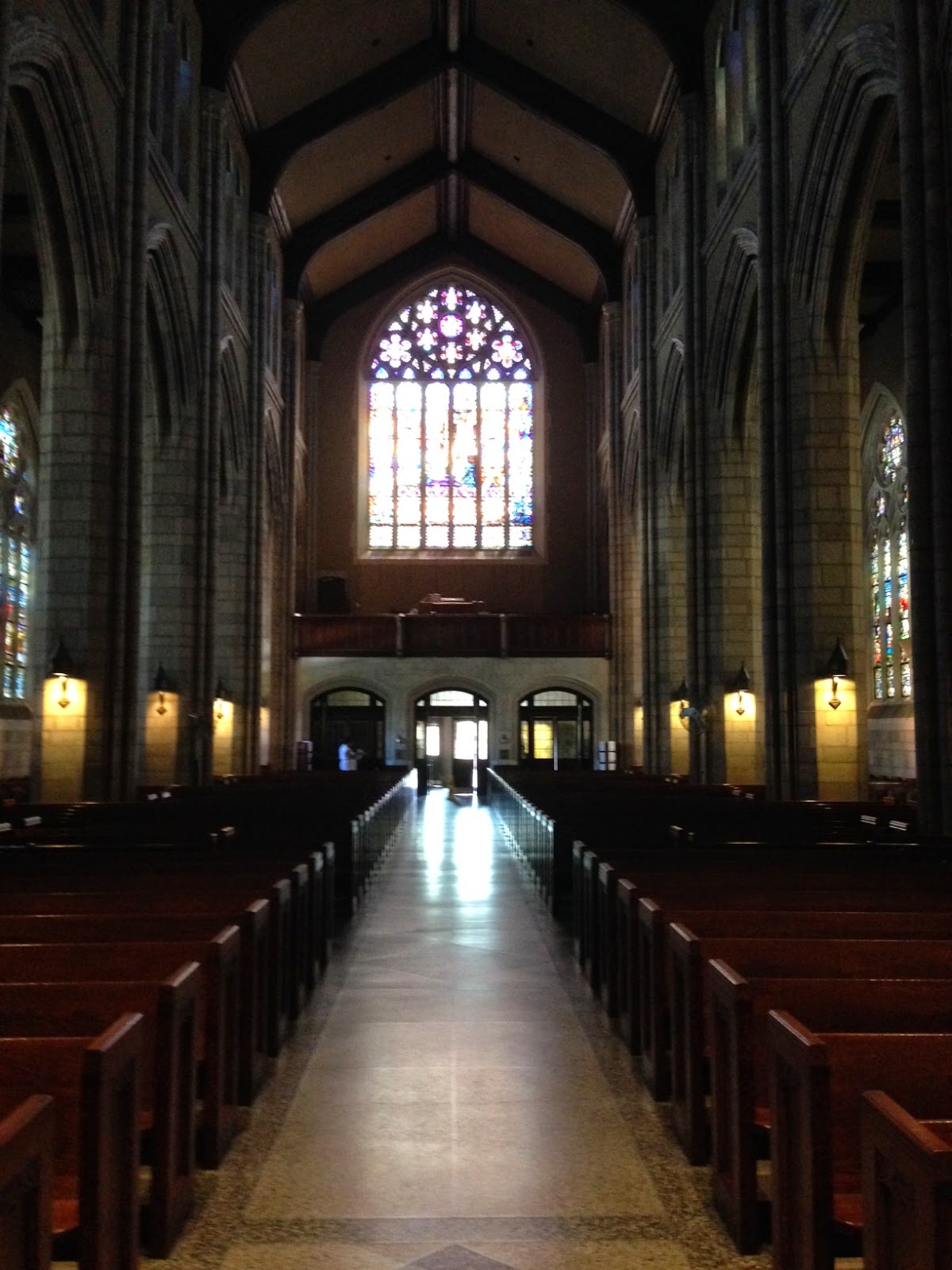
Then, back across the street to the church - in its time the unquestioned community center of the neighborhood. How well I recall the crowds spilling out of the church - upstairs and downstairs - on Sundays after each of the 13 Masses. The Lower Church is no more - converted decades ago to other parish uses. But the great Upper Church is little changed on the outside, and I found it only moderately altered on the inside. Its dark Gothic nave was as long and impressive as ever. The baldachin still stood over the altar. The light from outside still streamed through great window which portrays Saint Nicholas of Tolentine celebrating Mass and interceding for the souls in Purgatory (whose patron saint he is). 


I noticed a few alterations in the Upper Church. Some were dictated by the loss of the Lower Church - e.g., statues of Saint Nicholas and Saint Rita standing on their lovely little transept altars, somewhat incongruously in front of the stained-glass windows depicting them. And Our Lady of Good Counsel has also been brought upstairs and given her own chapel of sorts in what used to be the Baptistry. (The font is now in the sanctuary where the pulpit used to stand, and the pulpit - lowered in height - has been moved to the other side of the same sanctuary. This curious diminishing of pulpits is one of those nearly universal oddities that followed upon the Council's call for greater emphasis on proclamation and preaching!)

The two principal side altars - to the Sacred Heart and to the BVM  -have also for some reason been reversed in relation to the main altar, but have otherwise been well preserved. I think the Augustinians deserve great credit for maintaining this beautiful building as an attractive place of prayer and worship and thus the center of a still vibrant, and now multi-cultural, multi-lingual (English, Spanish, Vietnamese) parish community. It was a treat to walk around the old neighborhood today, but it was a special delight to spend time in reminiscence and prayer in the church that sanctified my early years.

Friday, July 4, 2014

Bookstores

In my early years, public libraries were special places for me. There I found frequent refuge from a less than welcoming world, while exploring - through the blessing of books - a more interesting and expansive one. As years passed (and turned into decades), bookstores replaced libraries for me as that special sort of sanctuary. In the 90s, I regularly walked the mile or so to Barnes & Noble at Broadway & 82nd Street. Then, for 10 happy years after moving back to Manhattan, I had access to a closer and bigger branch, augmented by an even closer Borders Bookstore at Columbus Circle.  Both of which, however, have long since been closed. So today I schlepped (not by foot this time, but by bus) back up to the 82nd Street Barnes & Noble, the only such bookstore left on the Upper West Side.

What does it mean that bookstores are dying off - not just here in Manhattan but all over the country? Nor are big chains the only ones so imperiled. The same fate has befallen so many big and small independent bookstores, both urban neighborhood and small town treasures alike. Such is progress - the "creative destruction" of a capitalist economy.  The publishing industry - specifically the economics of the publishing industry - continue to change. And who can say what will be in 5 years, 10 years, 50 years?  What kinds of books (real books, e-books) will exist? Will reading still liberate us?

I have no insights into the economics of publishing. I can only comment on what we all observe  - the growing vacancy in our culture. As I skimmed several books today - books I had not heard of or read reviews of  and might never have encountered had I not had a place to browse, I reflected on how much less that happens on line, where one is more likely to be looking for something specific and being pointed in particular directions. And then, of course, there is the whole community gathering place, local hang-out role that traditional stores perform in so many neighborhoods and towns.

For now at least,  it was a quiet but still glorious Fourth, surrounded by an abundance of books and a community of urban book-lovers.


Tuesday, July 1, 2014

Secularist Apoplexy

Some in the secular media seem to have become been virtually apoplectic in their reactions to yesterday’s Hobby Lobby decision. Once again, we’re hearing about a "war on women.” Much has been made, for example, of the fact that the 3 women justices – 3 of the only 4 women ever to have sat on the Supreme Court – were all on the dissenting side. (An alternative interpretation might be that political party probably had as much to do with the division than gender did, but whatever!)

A "War on Women” makes for a good campaign and fundraising slogan, however, and my guess is that much of the intense angst we are witnessing will work its way quickly into the mid-term campaign. And, given the fairly broad consensus in our society in favor of easy access to contraception, I would anticipate that it may well prove an effective issue in the campaign.

That said, the fact remains that no one is likely to lose access to contraception as a result of this decision. The Government failed to prove that the employer contraception mandate was the least burdensome way to accomplish its goal (according to the standard set by the Religious Freedom Restoration Act), at least in part because it has already established an alternative way to provide contraception coverage for employees of non-profit religious employers. All it has to do now is to make that same accommodation available to the kinds of companies covered by this case. (Of course, the Government could also just pay for the coverage directly, which would have avoided the whole conflict in the first place.)

The fact that an alternative is available – already exists – to guarantee contraception coverage clearly shows the factual falsehood of current “war on women” claims. So why the fuss?

What was clearly at stake here in this case was not whether women could get easy access to contraception coverage but whether other citizens (in this case, their employers) would be coerced into being accomplices to serve the extreme ideology of an expansive secularist state apparatus. From that ideological vantage point, of course, it might seem to make sense to prioritize such coerced cooperation, thereby institutionalizing the supremacy of secularist ideology and definitively privatizing contrary points of view (especially religious beliefs).

Yesterdays's Supreme Court decision is not likely to limit anyone's access to contraception. But it is a step toward restoring balance to our public life by acknowledging the legitimacy of multiple perspectives (including religious beliefs) - just in private but in the public square.