Monday, May 9, 2022
Another Trump-Biden Book
Sunday, May 8, 2022
To the Ends of the Earth
We get some sense of what that is supposed to mean from the Book of Revelation’s inspired vision of the heavenly liturgy, with its great multitude which no one could count, from every nation, race, people, and tongue. But how do we get from here to there? Getting from here to there – that’s the mission of the Church and the history of the Church, modeled for us in the Acts of the Apostles.
It’s called the Acts of the Apostles, but it is Paul who eventually emerges as one of (if not the) central figures in the history of the Church’s growth and expansion - perhaps because Paul was bi-cultural and bi-lingual, a Jew from a Greek city (and a Roman citizen besides). Such human and cultural considerations are always important, always have an impact on how effectively the Church fulfils its mission.
Most important, of course, Paul’s conversion to Christ was so complete that it compelled him to share Christ with everyone. Paul recognized in the Risen Lord, who had appeared to him, the fulfillment of God’s promise to Israel and God’s plan to include all people in that promise. Ultimately it was Christ who counted, and Paul saw no conflict between being a Gentile and faith in Jesus – thus making it possible for the Gospel to become Good News for all.
The world has changed a lot since Paul’s time, but the Church’s mission hasn’t. There is always a natural temptation to turn inward, to become a cozy community, caring a lot about ourselves, concerned with who we are and what we have. As a Church, we have been doing a lot of that lately. Indeed, ever since the 1960s we have been doing lots of that. It is certainly arguable that the Church may be less effective in her pastoral ministry and her missionary outreach to the wider world than might otherwise be the case, whenever more energy is directed to internal battles between and among factions and interest groups within the Church. But the mission of the Church, our literally quite Catholic mission, remains that of the Good Shepherd, whose voice in the world we now are – we, who have been commanded, as Paul was, to be an instrument of salvation to the ends of the earth.
On this annual World Day of Prayer for Vocations, we are also reminded of what we might call the “personnel needs” of the Church for it to fulfill its mission of making the Good Shepherd’s voice heard in today’s world. The wonderful story Acts tells of the growth and expansion of the Church needed people like Paul and Barnabas to respond to the Risen Christ’s invitation to full-time involvement in the mission – even at the risk, as Acts acknowledges, that such a life might put one at odds with prevailing cultural and societal trends.
All the more reason, therefore, why it is so necessary for all of us to be always ready to respond filled with joy and the Holy Spirit to the challenge of God’s call – whatever in particular it may be in our individual lives – and ever on the alert to identify, encourage, and support some future Paul or Barnabas, who may be right here in our community today and whose energy and commitment will be needed if the Good Shepherd’s voice is to continue to be heard in our world.
Homily for the 4th Sunday of Easter, Saint Paul the Apostle Church, NY, NY, May 8, 2022.
Wednesday, May 4, 2022
Making Sense of the Endless Easter Season
Sometime back in the 1980s, one of my seminary classmates ventured the opinion that the Easter season, as we now have it, is simply too long and should be confined to one week (in other words, to the existing Easter Octave). His argument, if I recall it correctly, was that it was just too difficult to sustain so much enthusiasm for seven long weeks. Certainly, in our contemporary world of radically reduced attention spans combined with our current addiction to celebration by anticipation (e.g., the way we celebrate Christmas before December 25 rather than starting on December 25), it seems our current seven-week Easter season is problematic. (In this discussion, I am, of course, completely prescinding from the obvious fact that, for many people, probably none of this matters at all. In a modern secular world, where religion itself, let alone liturgy, barely impinges upon the ordinary routines of life, whether it is Easter Time or, say, Advent, may matter much less than religious professionals would like to imagine.)
In any case, our current seven-week Easter season is itself a relatively recent construct, dating back only to Pope Saint Paul VI's 1969 calendar reform. "The fifty days from theSunday of the Resurrection to Pentecost Sunday are celebrated in joy and exultation as one feast day, indeed as one 'great Sunday'" (Universal Norms on the Liturgical Year and the Calendar, 22). This post-conciliar Easter season certainly recognizes some diversity within it - the Octave of Easter, Ascension Day, and the nine "weekdays from the Ascension up to and including the Saturday before Pentecost." But the prevailing tendency of the reformed calendar (evident even more so perhaps in its treatment of Lent) was to flatten such internal seasonal diversity in favor of a unified, somewhat monochromatic conception of the season as a whole.
Thus, for example, one of the most commented upon features of the contemporary version of the Easter season is the replacement of the traditional collects of the (themselves renamed) Sundays between Easter and Pentecost. The traditional collect for "Low Sunday" famously spoke of having completed the paschal festivities (paschalia festa peregimus), while those of the subsequent Sundays said nothing specific about Easter at all. This was seen as a serious problem by the liturgical bureaucrats charged with revising the Missal, and those collects have all accordingly been replaced - perhaps the best evidence of the intention to establish a uniformity in the Easter season over the seven-week period.
Of course, the old Paschaltide (like the current Easter season) had certain distinctive features that perdured uniformly throughout the entire time, notably the numerous alleluias, the Regina Caeli, and the Vidi Aquam. But, then as now, apart from the octaves, an ordinary saint's day took precedence over a ferial day. (In practice the ferial Mass was seldom celebrated anyway, yielding as in most of the rest of the year to the then much more popular Requiem Mass.)
That said, the current Easter season's predecessor seemed to take a more realistic, less uniform approach to sustaining prolonged celebration. Thus, the pre-conciliar Paschaltide, which ran from the beginning of the Mass of the Easter Vigil to None of the Saturday within the Octave of Pentecost, was explicitly defined to include a distinct season of Easter, a season of Ascension, and the Pentecost Octave. The difference between the Easter and Ascension seasons within Paschaltide was dramatized best by the requirement that the Paschal Candle, a symbol of the uniquely paschal presence of the Risen Christ, be solemnly extinguished after the Gospel at the Mass on Ascension Thursday and then removed from the sanctuary. Nowadays, of course, the paschal candle keeps reappearing all year (at baptisms and funerals, for example, and in many places where the baptistery is not really separate from the main body of the church it remain visible all year long). So the fact that it remains an extra 10 days after the Ascension may not seem so counter-symbolic as it obviously is. (Then again, I once witnessed the Paschal Candle ceremonially extinguished after the Gospel on Pentecost, an even more symbolically confusing conflation of old and new. Hopefully, no one went home imagining that it was the Pentecostal tongues of fire that were being extinguished!)
In addition to the major variations already mentioned, the traditional Paschaltide also included the "Lesser Litanies," that is, the three Rogation Days" on the Monday, Tuesday, and Wednesday before the Ascension. (In Milan, they were more logically celebrated on the Monday, Tuesday, and Wednesday after the Ascension.) And the Octave of Pentecost included the summer Ember Days, somewhat contradicting the ancient notion that there should be no fasting during the Easter season.
But, other than celebration fatigue and the shortened attention span problem already alluded to, perhaps the difficulty resides not so much in the desire to sustain celebration for too long a time as in the flattening of that same time by the downgrading of Ascension and Pentecost. Along with Christmas and Epiphany, the feasts of Easter, Ascension, and Pentecost are the five principal festivals of the liturgical calendar, still distinguished as such in the Roman Canon and previously distinguished by Octaves. There is a certain logic to dividing "the 50 days" into an Easter 40 and an Ascension 10, not least in order to correspond with some fidelity to the biblical account. The modest reference in the present arrangement to the weekdays between Ascension and Pentecost as ever so slightly set apart from the rest of the season represents a minimalistic vestige of that division. In the absence of an Ascension octave, treating Ascension Thursday (obviously always on Thursday) as the end of the specifically Easter season, followed by a nine-day period of preparation for Pentecost would be one way of making sense of the season.
That still leaves the problem of Pentecost and its now lost octave. Whether due to the reformers' apparent antipathy to octaves in general and to an overly literal obsession with the number 50, the destruction of the Pentecost octave can only be seen as a (presumably irreparable) loss. According to the familiar story, when Pope Paul VI went to vest for Mass on the day after Pentecost in 1970, and found green vestments laid out for him, he asked "Where are the red vestments?” He was told that the Octave of Pentecost had been abolished. “Who did that?” he supposedly asked, only to be told “Your Holiness, you did.” And so the story concludes, the pope wept. Whether true or apocryphal, the story does express the damage done to the liturgy by the gratuitous abolition of the Pentecost Octave. More recently, Pope Francis has made a small gesture to correcting that mistake by instituting the Memorial of the Blessed Virgin Mary, Mother of the Church, to be celebrated always on the Monday after Pentecost.
Restoring a sense of Easter not as a uniformly flat time but as a season with several (specifically three) peak moments might help to retrieve Ascension and Pentecost as feasts truly celebrating the beginning of the Church's current life.
Meanwhile, on the ground in the real world of contemporary American religion, the peak moments of the otherwise flattened Easter season will continue to be First Communions, Confirmations, Graduations, maybe May Crownings, and the biggest American pseudo-religious commercial feast of all, Mother's Day.
(Photo: Easter 1963, St. Nicholas of Tolentine Church, Bronx, NY)
Sunday, May 1, 2022
May Day
One of the ironies of modern history is that May Day, for centuries a major seasonal turning point (the first day of summer) in an agriculturally oriented, nature-based calendar, became in the 19th century a day dedicated - of all post-agricultural, post nature-based things - to modern industrial labor and the proletariat it produced. Before it became an International Workers' Holiday, May Day was more about dancing around the maypole and crowning the May Queen (a remote antecedent of the contemporary Catholic May Procession and Crowning). Undoubtedly, some contemporary "neopagans" may be reconstructing some of those older nature-cycle pagan festivals and again celebrating May Day as a pagan religious festival
May Day still survives as a workers' holiday, of course, but barely (following the collapse of communism and the eclipse of socialism). In the United States, where we have a different "Labor Day" holiday and May Day has accordingly always resonated less among the "working classes" than in Europe, it is the labor movement itself which has been eclipsed. In the 20th century, as Michael Kazin has shown in What it Took To Win: A History of the Democratic Party (Farrar, /Strauss, and Giroux, 2022), the U.S. Democratic Party became briefly, but very successfully, an American Labor Party. But those days appear long gone, and the U.S. Democratic Party has long since abandoned its identification with the "working classes" (to the party's own electoral detriment, as well as the detriment of the "working classes").
The political abandonment of the "working classes" has come about much more slowly in Europe. Moreover, the mid-20th-century post-war period in Europe was characterized by authentic religious outreach as well. This was reflected, for example, in the Mission de France and the "worker-priests" movement and, somewhat more superficially, in the mid-1950s invention of the Roman Catholic liturgical feast (photo) of S. Joseph Opifex, assigned by Pope Pius XII to this date, somewhat ironically referred to in the feast's original office as "a day which the workers have adopted as their own." While the new festival famously failed to outperform the more popular leftist May Day, in the process the new observance did displace another relatively modern feast in the Catholic calendar, that of the Patronage of Saint Joseph, celebrated in the 19th century on the Third Sunday after Easter and then in the 20th century on the Third Wednesday after Easter. Pius XII's ineffective innovation still survives - somewhat vestigially and not much noticed - in the Church's contemporary calendar.
In 2005, the newly elected Pope Benedict XVI (whose own given name, of course, was Joseph) made the best of what the calendar offered, somewhat unconvincingly calling this observance in honor of Saint Joseph the Worker "a liturgical Memorial very dear to the Christian people." Recalling how it had been established "to highlight the importance of work and of the presence of Christ and his Church in the working world," he expressed his "hope that work will be available, especially for young people, and that working conditions may be ever more respectful of the dignity of the human person."
Friday, April 29, 2022
An Imaginative Adventure in Constitution-Making
Back in the 1970s, there was some talk (in the end, only talk) about invoking Article V to convoke a new constitutional convention. I was mildly supportive of the idea, mainly because I envisioned it as a rare opportunity to revive the participatory citizenship that had been eclipsed by the late 20th-century model of Americans as consumers rather than citizens. in fact, a new constitutional convention had no realistic chance of happening then. Nor does it now, although now (unlike then) there is increasing awareness of "how the document has helped foster a hopelessly broken government."
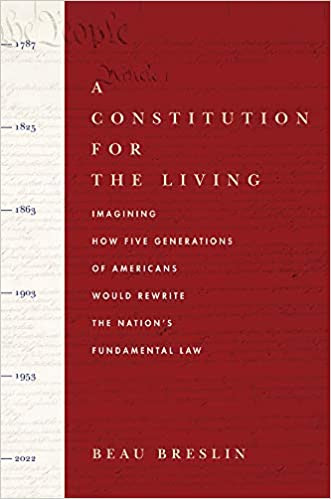
The author of that diagnosis, Political Scientist Beau Breslin, has recently responded to this discouraging reality with an imaginative exercise, A Constitution for the Living: Imagining How Five Generations of Americans Would Rewrite the Nation's Fundamental Law (Stanford U. Pr., 2021). The basis for Breslin's exercise is Thomas Jefferson's idiosyncratic (to my mind, completely crazy) that each generation should be free to start the constitutional process over again. One doesn't have to be a full-bore Burkean to sense the absurdity of Jefferson's position. Even so, one can also appreciate its appeal. In any case, Breslin takes Jefferson's idea and imagines what would have happened had the U.S. constitution been renegotiated and rewritten by each "generation." For Jefferson, that would have been every 19 years. Recognizing the increasing length of modern lifespans, Breslin opts for imagining new constitutional conventions in 1825, 1863, 1903, 1953, and 2022.
Obviously this is an exercise in counter-factual history. However, Breslin works hard to imagine how each constitutional rewrite might have worked out, based on what was actually happening in American society at the time - including, for example, what was being written in new or revised state constitutions in each period. so, while obviously an exercise in imaginative fantasy, Breslin's imagined constitutional renegotiations do open a window into the complexities of our constitution's adaptiveness to the dramatic changes in society.
Personally, while I have no use for Jefferson's anti-historic theory of generational independence, I do believe that times and circumstances do change and that with those changed times and circumstances comes a need for social and political change, including institutional adaptation. Breslin's book both recognizes this and show us how it might have happened (and could yet happen through our more cumbersome amendment process).
In Breslin's account, the first such imagined "convention" occurred in 1825, one year after the contested 1824 election, in which the House of Representatives elected John Quincy Adams over Andrew Jackson (who had gotten the most votes in the original election). Unsurprisingly, the convention reexamined the Electoral College. And, in a major victory for the Jacksonian Democrats, the 1825 Constitution provided for the popular election of presidential electors. In a similar vein the new document guaranteed universal white male suffrage. (Both were in fact the actual direction in which most states were tending at the time.) Bringing the federal constitution into greater harmony with most state constitutions, the imagined 1825 document relocated the Bill of Rights as the first article of the federal constitution, thus highlighting its priority. But an attempt to include a right to education was voted down. Even staunch Jacksonians "could not see their way to supporting the interests of the free common man if that meant states had to relinquish control over their own educational systems." Breslin's imagined convention's most significant change to its 1787 predecessor was one which was not reflected in American historical reality, a change in the manner of staffing the federal judiciary.
The 1863 convention occurred, of course, during the Civil War. As part of the dramatic fiction, Breslin has it relocated from Philadelphia to Boston to avoid danger from Lee's Confederate army. Not surprisingly, given the absence of representatives from the southern states and the dominance of the radical wing of the Republican party, what this convention produced closely resembles the actual federal constitution as radically amended after the Civil War by the 13th, 14th, and 15th amendments. In fact, the three Reconstruction Amendments did actually give the U.S. a radically revised constitution, but (we all know the sad story) the federal government failed to enforce that new constitution - with calamitous consequences we are still dealign with today.
The next 50 years were defined by the rise of commercial capitalism and urban immigration, thus definitely putting behind the Jeffersonian-Jacksonian vision. As Breslin notes, "the framers of the 1863 Constitution likely would not even have recognized their own country in 1903." In actual history, of course, Theodore Roosevelt was president, and it was the Progressive Era. So unsurprisingly, women's suffrage passed at Breslin's 1903 convention, but proposals to recover for Native-Americans a degree of self-rule over Indian lands was defeated. finally, reflecting the then reigning imperial turn in American foreign policy, the convention enhanced presidential power in that are, allowing the president to "pursue strategic national interests abroad" and to "execute all necessary and proper policies to protect the country;'s vital global interests."
So again the imaginary 1903 convention largely condenses what actually happened. (In fact, the constitution has never really been amended to reflect either American Empire or the imperial presidency that necessarily accompanies it, but Breslin's device does reflect the de facto acceptance of almost unlimited presidential power in this area.)
Imagined constitutional changes cannot stray too far from what actually has happened for obvious reasons. "Efforts to raze the prior Constitution altogether and take a fresh look at what a twentieth-century generation might might desire failed" at Breslin's imagined 1903 convention, "because of expediency and because of a belief that the basic architecture of the American political system still functioned reasonably well."
The 1953 iteration of this fantasy project produced a longer constitution, "and the evidence of interest group activity was obvious." Another background difference was that state constitution framing had diminished in the interim, although state constitutional amendments had "increased dramatically" in those 50 years.
Obviously, the 1953 convention reflected the enormous changes in federal and presidential power during the New Deal and two world wars. America "had been molded in FDR's image" and all "were now living in FDR's world." The 1953 convention limited presidents to two terms (in the exact language of the actual 22nd Amendment). Reflecting the increasing primacy of national identity, the convention called for unanimity among all 48 states as a requirement for ratification.
The convention's preoccupation with recent Supreme Court decisions highlights one practical problem with this thought experiment. The 1825 convention had altered the way the federal judiciary was filled. But, since that never actually happened, the court decisions that impacted American society between then and now are the same.
All of which brings us at last to our problematic present - in the form of the constitutional convention of 2022. Breslin adapts his model to current technology and employs a cumbersome "crowdsourcing" preparation. (And, of course, C-Span covers the convention live.) But the most decisive factor was (i.e., is) "the deep divide - political and otherwise - facing the country."
Unsurprisingly, the 2022 convention is the first since 1787 to reconsider "the basic architecture of American government." The imagined debate begins with the perennially popular, if controversial, question of term limits. The arguments on both sides are familiar and need not be repeated here. In the end, Breslin's convention limits House members to four terms and Senators to two, but (to my mind much more importantly) prohibits former lawmakers from becoming lobbyists for four years after leaving congress.
Climate change is perhaps the major issue facing the world today. Already, several state constitutions include some reference to the environment. Breslin's 2022 constitution includes a constitutional right (albeit perhaps primarily hortatory) to a clean and healthy environment. As we all know, the problem with protecting the environment and fighting climate change is not acknowledging its desirability but taking actions that actually require a change in our current, wasteful way of life.
At this point Breslin become effectively an advocate for Sanford Levinson's constitutional reform agenda, addressing "the illegitimacy of the Senate, the inability of the people to vote that they had 'no confidence' in their President, and the absurdly difficult method for amending or reforming the constitutional document." Of course, Breslin's jeffersonian fantasy of regular constitutional conventions were a reality, Levinson's legitimate concern about the inordinate difficulty of amending the constitution would be mulch less salient!
Levinson's proposal for a parliamentary-style congressional vote of "no confidence" reflects the abysmal history of presidential impeachment and its effective irrelevance as a constitutional tool. Breslin's convention adopts "no confidence," but not Levinson's more radical suggestion of a national recall. (Hasn't California sufficiently taught us the harm recalls can do?) Most importantly, however, at the 2022 convention, the Electoral College is finally abolished, which alone might make such an exercise a valuable one!
Thanks to the crowdsourcing technique (and reflecting our presently polarized politics) controversial cultural questions are also debated at this final convention. Neither side being willing to concede any ground on abortion and a constitutional right to privacy, the convention reflects contemporary reality by tabling the topic and never returning to it. On the other hand, obviously reflecting the apparent trajectory of public opinion (at least until recently), "marriage equality" is more successful in getting enshrined in the constitution. (This book was obviously written before the contemporary Republican party's renewed anti-gay panic.)
Gun rights, like abortion, are an area where the division between Americans is too wide and too deep, and even at a fictional convention no change is possible.
Finally, in an effort to come to terms with America's problematic past, the venerable Preamble (which my generation faithfully memorized in school) is lengthened to list all sorts of now lamented past evils.
Breslin does a very good job getting the reader to play along and imagine these various conventions. It is a salutary reminder that a more participatory process and altered institutions should not be beyond the pale of our imagination. At the same time, it illustrates how, while constitutional arrangements may complicate our political problems and make them worse) they do largely reflect our problems and divisions, thereby limiting the realistic extent of what alternatives may realistically be imagined.