Thursday, March 24, 2022

Relearning "Warm" War


I was born in the early years of the Cold War, when a world devastated by a recent red-hot world war, found itself divided into two hostile camps, the Western "Free World" vs. the Soviet "Evil Empire." Now, 74 years later, a West, devastated in different ways by prosperity and self-inflicted moral and cultural decadence, is once again responding to Russia's aggressive aspirations to regain its "Evil Empire." The year I was born, the West, under U.S. leadership, boldly responded to Soviet aggression, navigating the narrow space between the scylla of "hot" war and the charybdis of appeasement, by means of the Berlin Airlift.  Such is the sort of "warm" war response, which the U.S. and its NATO allies are struggling to craft in response to Russian aggression against Ukraine.

Mesmerized by the historical lesson of the failure of appeasement in the 1930s, the Cold War at times led to tragic overreach, most notably in Vietnam, an experience which has undermined American self-confidence for generations. On the other side, the Soviets' own overreach in Afghanistan actually helped to undermine the Soviet Union itself and exposed its inherent fragility to all to see. After our own post-Cold War overreach in Afghanistan and Iraq, the U.S., under President Biden's moderate, steady leadership, formed from the lessons of the Cold War rather than delusions about the either an "end of history" or some mythical "arc of history," seems to have recalibrated and relearned the art of "warm" war.

Unlike South Vietnam, a client state with an ambiguous national identity and limited commitment to defeat the enemy, Ukraine has revealed itself to be (notwithstanding Putin's claims to the contrary) a real country with an authentic national identity and a broadly shared societal commitment defeat its enemy. American assistance actually might make a difference, not just in prolonging some sort of stalemate (as in other recent American interventions) but in actually helping Ukraine to save its sovereignty and achieve the victory it deserves and needs and the defeat that Russia deserves and needs.

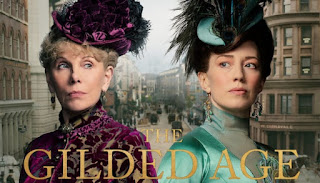
The neo-isolationists (a perennial plague in American politics) correctly sense that any alternative to appeasement involves risk (as if appeasement didn't entail risks of its own). But, as The Gilded Age's Berha Russell would say, "whoever achieved great things without taking a chance?" Let us hope that President Biden and his fellow NATO leaders, meeting today in Brussels, will combine courage and prudence in assessing opportunity and minimizing risk and re-learn the Cold War art of "warm" war to save Ukraine's national sovereignty and forge a more promising future for Europe and the world outside of Russia's "Evil Empire."

Слава Україні!

(Glory to Ukraine!)

Tuesday, March 22, 2022

"Here We Are, All of Us Together" - The Gilded Age (Season Finale)


The Gilded Age: A Tale of Today was the title of an 1873 satirical novel by Mark Twain and Charles Dudley Warner (Twain's only co-authored novel). That novel satirized greed and corruption in post-Civil War American society. Its title has since became synonymous with the last quarter of the 19th-century in the United States and the greedy, materialistically stratified society and corrupt public life widely recognized as characteristic of that particular period. The Gilded Age is now also famously the title of the successful HBO series, supposedly set in New York in 1882 and created by Julian Fellowes (of Downton Abbey fame). I wrote about the series' first episode earlier, at: 

https://www.blogger.com/blog/post/edit/1538477881080991285/1711702638689996921?hl=en

Eight episodes later, The Gilded Age has lived up to the promise implicit in any costume drama "period-piece" of highlighting what was attractive in such previous eras - lavish lifestyles, beautiful clothes, and good manners (the latter two being especially notably lacking and rightly missed today).

In the season finale, George Russell having dramatically overcome two significant challenges to his financial and political power, Bertha Russell likewise succeeds in her over-the-top social ambitions. Gladys gets her ball at last and is now "out," but the ball was as much Bertha's ball as hers, her moment of triumph standing at long last next to Mrs. Astor, with Ward McAllister intoning, "Here we are, all of us together."

Less happily, Marion's heartbreak, which in retrospect was probably predictable, highlights the emotional toll of all this social stratification. But Marion seems primed to get over Tom, and (as watchers have likely long suspected) Larry (another Australian actor!) is at the ready to replace him, and is obviously a much more suitable substitute. 

All's well that ends well - except perhaps for Peggy and her already fractured family, devastated by the discovery that her baby boy is alive.

The Gilded Age successfully recreates the social whirl and mores of late 129th-century New York high society in all its charming politesse and its roots in rapacious capitalist greed.

Five years after the supposed date of the HBO series, Edward Bellamy wrote another Gilded Age themed novel, Looking Backward, set in the year 2000 and (as an alternative to the greedy, materialistically stratified society and the corrupt public life of the Gilded Age) portraying a utopian, quasi-socialist society, in which the distinction between rich and poor has effectively been overcome and in which everyone under 45 must work (but only four days a week with lots of leisure time for high-brow pursuits). That pivotal year 2000 has come and gone, and we find ourselves nowhere near Bellamy's anti-gilded Age utopia. Instead, we are rapidly regressing back to the worst aspects of Gilded Age inequality and greed, without any of the benefits of high-minded leisure pursuits, let alone beautiful clothes and good manners!

Monday, March 21, 2022

The Complex Clarity of Civilizational Conflict


Back in 1992, in the absurdly optimistic interval that followed the unexpectedly sudden collapse of the Soviet Union and the de facto end of the Cold War, Francis Fukuyama famously wrote The End of History and the Last Man, which argued, in a rather Hegelian way, that history had run its course and reached its final form. This resonated with the then increasingly widely held (even if erroneous) belief that the only remaining alternative for nations in the post–Cold War world would be some version of American or European capitalist, liberal democracy. In contrast, others argued that, after the aberration of the Cold War, world politics and international relations would revert to something like the traditional, normal, non-ideological, interest-based conflicts between nation-states.  Meanwhile, borrowing a phrase already used by Albert Camus, Bernard Lewis, and others,  Samuel Huntington wrote about a "clash of civilizations" (which became the title first of a 1993 Foreign affairs article and then a 1996 book The Clash of Civilizations and the Remaking of World Order). Huntington's analysis controversially hypothesized a world of several competing cultural identities or civilizations rivaling one another in a new post-colonial world. Contrary to the ideology of secularization still so dominant intellectually, Huntington hypothesized how cultural and religious identities would increasingly shape post-cold War conflicts. His argument reflected (and benefited from), for example, what was being experienced in Europe after the breakup of Yugoslavia and even before that the islamic Revolution in Iran. While limited in its applicability and problematic in some of its assumptions, this theory of increasing civilizational conflict did serve as a sort of counter to the Western-centric civilizational ideology that asserted the inherent universality American and European political and economic values, implicitly minimizing the popularity and resilience of other cultural models.

My own thinking has largely been a pragmatic variation on a realist model, which starts with the existence of modern nation-states with specific geopolitical interests, but one which recognizes that ideological and cultural factors and religious and moral values play an important part in a nation's self-understanding and become, in effect, a real dimension of its "interests." Thus, during the Cold War, one did not need to start from communist ideology to understand the Soviet Union's policy in guaranteeing for itself a sphere of influence in Eastern Europe. Russia having been many times invaded from the West, most recently in the 19th century by Napoleon and in the 20th century twice by Germany, it was easy to understand the Soviet Union's security interest in controlling eastern Europe and its motivation in maintaining the division of Germany and a strong Soviet presence in what became the Warsaw pact. On the other hand, the "Finlandization" solution was confined to Finland and Austria, while explicitly communist governments and the ideological apparatus that accompanied communism were imposed on those other Warsaw pact countries. And there can be no doubt that the way both Stalin and subsequent Soviet leaders looked at and interpreted U.S. and NATO behavior was intensely colored both by traditional imperial and Orthodox Russian distrust of the "Latin" West and a distinctive Marxist-Leninist interpretation of the motivation and behavior of capitalist states. If that last factor is less salient now, it may still survive subconsciously among leaders like Putin who were socialized under Marxist-Leninist ideology, while the more traditional imperial and older Orthodox distrust of the West may be even more salient now that it is no longer ideologically subordinated to communism.

All of this is, I think, relevant to understanding the current conflict between Russia and Ukraine, which remains rooted in a certain Russian interpretation of its national interests within the modern nation-state system, clearly colored by and filtered through its inherited imperial and Orthodox cultural self-understanding and interpretation of the outside world.

Meanwhile, while it is certainly true that Ukrainian national resistance and NATO support for Ukraine can be explained in part in realist terms, that is a limited understanding of the revived appreciation of the perennial cultural conflict between Russia and the West. (Remember Tocqueville!)

It was NATO more than the EU, and the Cold War need for common defense against Soviet expansion more than the shared experience of capitalist, liberal democracy that held the western alliance together so effectively while the Soviet Union was still a real threat. The rapid loss of common civilizational clarity among Western societies, both in North American and Europe, after the end of the Cold War was obviously a reflection of that. Now that the threat is somewhat more clear again, the Western world seems to be recovering (at least for a time) some of tis civilizational clarity. That China, India, and the Muslim nations seem relatively reluctant to get on board likewise reflects not just those countries' different geopolitical situations, but the different cultural and philosophical filters through which they interpret themselves and the world.

Western civilization predates capitalist, liberal democracy and includes a complex of cultural and moral values and religious interpretations, some of which compete with rather than reinforce capitalism and liberal democracy, but which nonetheless remain significant still. That said, all those occasionally competing components have come to coexist within a successful Western paradigm of political pluralism which Russian history leaves little room for, in contrast to Ukraine's historically more Western orientation.

So one collateral consequence of this horribly tragic war may be a healthy renewal of Western nations' shared self-understanding in all its varied complexity - less as a mission to impose capitalist, liberal democracy on others who may not presently want it and more as a renewed appreciation of the abiding strength found in the historical evolution of Western European and American political and cultural values, which recent circumstances have conspired to undermine at home as well as abroad. 


Слава Україні!

(Glory to Ukraine!)


Sunday, March 20, 2022

Spring


At 11:33 a.m. today, the sun will shine directly above the equator, dividing the day into equal hours of light and dark. Spring has come to 2022. Beyond the inevitable increase in sneezing and other allergic afflictions, spring suggests mild temperatures, refreshing rain, pretty plants, colorful flowers, and doing things outdoors more than one did in winter. Before the climate got so hopelessly distorted, spring was a serious season that lasted a predictable amount of time and had its own appropriate attire. (Does anyone remember "spring coats"?) Nowadays, sadly, spring increasingly comes quickly and goes almost as quickly, as winter rapidly turns into summer. Very cold days are soon succeeded by very hot days with only a modest interval in between, the interval we have historically experienced and celebrated as spring.

This year, spring signifies something more. The milder weather that invites one to venture outdoors parallels the milder socio-political environment of rapidly diminishing covid anxiety as more and more restrictions and pandemic precautions are allowed to lapse. My guess is that the rush to unmask may be too rushed, and we may yet regret allowing a selfish "done with covid" mentality to dominate decision-making. In my opinion, the change in our behavior as the pandemic crisis wanes ought to be more cautious - as gradual as the change in the weather once was. Meanwhile, we seem caught between two extremes - a minority marooned in a forever winter in which the maximum precautions continue indefinitely as our "new normal," and a growing majority ready for an early summer in which we carelessly shed all restraints and precautions right way. For myself, I rather wish we were still in some spring-like middle. 

At its best, spring is to be savored as a sign of hope - for our ancestors, hope for a good harvest to see them through another year in this vale of tears; for us, hope for whatever it is we have set our hearts on, at minimum some sort of return to normalcy, whatever that may mean in the new world we now live in. Myself, in many ways more a winter than a summer person, I accept the promise of spring but am content to live in that hope without embracing our changing climate's unseemly rush to summer and our analogous political impatience to be "done with covid."


Saturday, March 19, 2022

A Little Man in a Big Job


The ordinary guy, of whom little is expected, of whom nothing extraordinary is ever expected, until he does the opposite, is a familiar figure in history, literature, and life - think Abraham Lincoln, or Ron Weasley in Harry Potter, and - most relevant right now - embattled Ukraine's heroic President Volodymyr Zelenskyy. The hero of the hour is young (44) and, until relatively recently, that is, prior to becoming a president, was a performer, a comedian, who danced with the stars and played a president on TV. Now he is a real president, the leader of a nation at war, and performing better in that role than most of his critics (and perhaps even his fans) might have expected. 


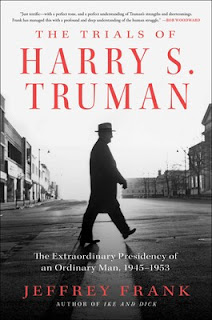
In the 20th century, the classic exemplar of that traditional trope of the ordinary man of who little was expected but who turned out to be an extraordinary leader, was Harry S Truman, the 33rd President of the United States. My father was a great admirer of President Truman, and at least one element in his admiration of Truman was that Truman had never gone to college. I always assumed Truman was the last U.S. President not to have gone to college. From Jeffrey Franks's new book on Truman, The Trials of Harry S. Truman: the Extraordinary Presidency of an Ordinary man, 1945-1953 (Simon and Schuster, 2022), I learned that Truman was the only president never to attend college, Like the period after the "S" in Truman' name, I think that may be a mistake on the author's part. I don't think George Washington ever attended college. (There were only two in British North America at the time, and Washington never traveled to Europe.) But the basic point remains. Everything about Truman and his background and previous accomplishments was ordinary and unpromising as a predictor of the great president he proved to be.


And Truman had the added disadvantage of replacing Roosevelt! Frank relates the familiar anecdotes about how, when Truman entered the East Room for FDR's funeral service, no one stood, because, so it seemed at the time, those there “could not yet associate him with his high office; all they could think of was that the President was dead.”


Frank starts his story with a quote from Roy Roberts of the Kansas City Star, "not a Truman admirer," who "was struck by the idea that someone who not so long before 'was still looking at the rear end of a horse' should find himself leading the world’s most powerful nation. 'What a story in democracy,' he wrote, and added, 'What a test of democracy, if it works.' What a test indeed."


Like Frank, I think,Truman clearly passed that test - and with him democracy - despite what we might label his cultured despisers, such as those Washington "insiders," for whom "the very idea of Harry Truman as the nation’s leader was so off-putting."


That said, it does not follow that ignorance and inexperience are virtues to be lauded as what we commonly call  "populism" seems to suggest.  Franks himself noted Truman's limited knowledge and how. in the first test of Truman's international leadership, the Potsdam Conference, his provincialism was disastrously on display. But Truman was, as Churchill described him "a man of immense determination," who "takes no notice of delicate ground, he just plants his foot down firmly on it." And, just weeks after his unexpected accession to the presidency, Dean Acheson said of Truman that, despite “the limitations upon his judgment and wisdom that the limitations of his experience produce,” he believed that “he will learn fast and will inspire confidence.” Above all, Frank notes, Acheson judged Truman to be “straight-forward, decisive, simple, entirely honest.”


Frank takes us through Truman's almost eight years in the presidency. He highlights Truman's attraction to "the sociability of politics" and the problems that could result at times from that. We see Truman's complexities, for example, his almost [populist disdain for elites, combined with his reverence for someone like General George Marshall. We are taken back to the critical early days of the Cold War, when the pressure to bring American soldiers home was overwhelming, but so was Truman's recognition of the growing and seemingly inevitable threat of Soviet expansionism, which required a new dominant power to replace the depleted British and French empires. Of course, the atomic bomb gets attention - both its use to end the war successfully and then its perennial presence in the background of all subsequent conflicts, especially the largely disastrous Korean "police action."


Not unlike contemporary politicians, Truman suffered from the swings of popular opinion - from the  catastrophic midterm elections of 1946 to Truman's amazing comeback in 1948. All the major high points are covered - the Truman Doctrine, the Marshall Plan, the Berlin Airlift, the 1948 turn to civil rights and the resultant Dixiecrat walkout, Israel, Korea, Joe McCarthy, General Mac Arthur, the steel strike, the 1952 election and the quarrel with Eisenhower - comprehensively revisiting "a time that was contentious and dangerous, triumphant and tragic."


As Republican Senator Vandenberg said of Truman on the morning after the 1948 election. “You’ve got to give the little man credit. Everyone had counted him out but he came up fighting and won the battle. He did it all by himself. That’s the kind of courage the American people admire.”